No Wagering Casino Welcome Bonus UK: Smaller Headline, Real Cash
 Available in GB
The Smallest Bonus I Ever Recommended Was £5
A friend asked me last December which welcome offer she should accept on a £25 budget. I told her to take the £5 no-wagering bonus over the £25 matched deposit, and she thought I had lost the thread. The £5 was sitting next to a £25 figure on the same comparison page. Six weeks later she sent me a screenshot of her cleared £5 in her bank account and a comment that read, simply, ‘I see what you meant’.

That is the paradox the no-wagering category sits on top of. The headline figures are smaller than any other bonus shape on the market. The expected value to the player is often the highest of any bonus shape on the market. Most readers cannot reconcile those two facts at first glance, because the British casino market has spent two decades training players to read the headline number as the value of the offer. Wager-free bonuses break that habit, and they break it for a real reason. The full picture is in our guide to the UK casino welcome bonus.
What Wager-Free Actually Means
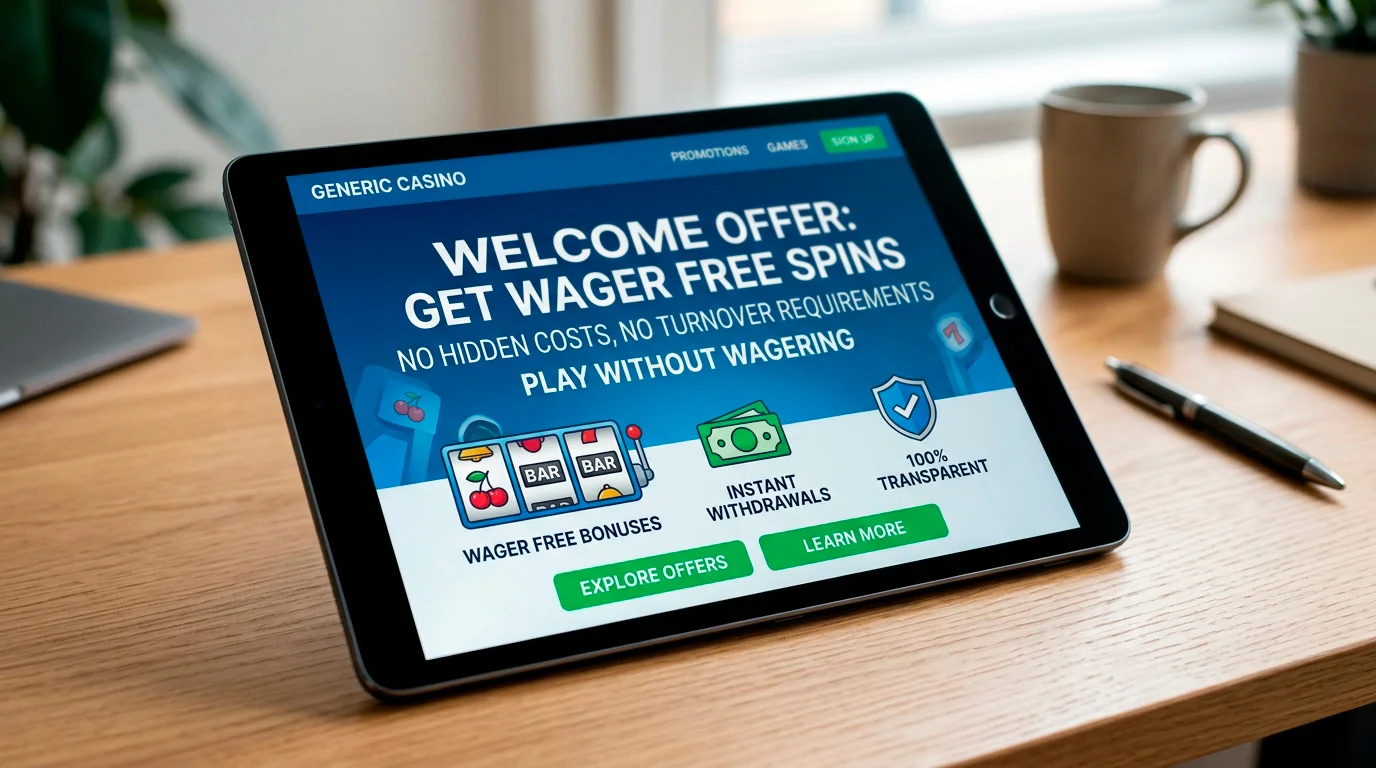
A no-wagering bonus is exactly what the label says. The bonus credit, or the winnings from the free spins it ships with, can be withdrawn the moment the spins finish — no turnover requirement, no playthrough, no rollover. The cash is genuinely cash from the first second it sits in your balance. There is no second pipe, no contribution percentage, no carryover. The whole compliance burden of explaining wagering is removed, which is why operators offering wager-free bonuses tend to write the cleanest T&Cs in the market.

The structural change since 19 January 2026 has made wager-free a more interesting category than it used to be. Under the old 50× regime, a £20 wager-free bonus was visibly more valuable than a £20 matched deposit with 50× wagering. The matched deposit required £1,000 of turnover; the expected friction at a 4% house edge was £40, leaving an expected residual far below the headline. The wager-free bonus had a residual equal to the headline. After the reform, matched-deposit wagering is capped at 10× and the friction differential has shrunk dramatically — but it has not vanished. A £20 no-wagering offer still beats a £20 matched offer at 10× wagering in expected value, by around £8 across the friction window. Compared against a 10x match: three worked examples.
The price the operator extracts for the cleaner shape is a smaller headline figure. The market has settled around £5 to £20 of no-wagering bonus value, occasionally extended to bundles of 10 or 20 wager-free spins. Compared to the £50 to £200 figures common on matched-deposit headlines, that looks miserly. Once the wagering arithmetic is done, the no-wagering offer is usually within a couple of pounds of the matched offer in expected value — and is real money the moment it credits.
Headline Versus Headache: Where The Choice Actually Sits
The real comparison is not between headline numbers. It is between cleared cash and theoretical cash, weighted by the probability that you actually finish the wagering on the non-wager-free option. That probability is the elephant in every UK welcome bonus discussion.

Reader behaviour data is hard to come by, but operator-side anecdotes converge on a familiar number. Somewhere between 60% and 80% of players who opt in to a wagering-bearing bonus do not clear it. They either bust before reaching turnover, abandon the offer before expiry, or breach a T&C and have winnings voided. That figure was unsustainable for the player long before the 10× cap, which is part of why the Commission moved on the reform. The cap reduced the requirement, but it did not change the variance of slot play — the modal player still busts before clearing, just over a shorter session.
Against that backdrop, a no-wagering bonus with a £10 cap delivers £10 in 100% of cases where the spins or credit are used at all. The matched deposit at the same nominal headline delivers an expected value perhaps slightly higher, but only if the player clears, and most do not. The risk-adjusted comparison favours wager-free for any player who is not certain they will complete turnover — which is most players.
Who Actually Offers Wager-Free Welcomes
The wager-free welcome offer is a positioning choice rather than a product norm. A handful of UK operators have built their identity around it, and most others run wagering-bearing offers as the default with the occasional wager-free promotion layered on top. The remote casino segment delivered £1.4 billion of revenue in the financial year to March 2025 across an enormous range of operators, and the wager-free positioning sits at the smaller, often newer end of that spectrum.
The reason is commercial. A wager-free offer has a known cost to the operator — the bonus headline equals the maximum cost — which makes acquisition spend easy to model and easy to cap. A wagering-bearing offer has an expected cost that depends on player behaviour, and the operator captures some portion of bonus turnover back through the house edge during the clearing process. For a brand competing on margin, the wagering-bearing offer is more efficient; for a brand competing on player trust and word of mouth, the wager-free offer is the cleaner positioning.
The category has been quietly stable through the 2025-26 reforms, partly because the LCCP changes did not touch wager-free designs directly. Where the matched-deposit category had to be re-engineered around a 10× cap, the wager-free category was already compliant with anything the Commission might want to throw at it. That stability is one of the reasons I expect to see more wager-free positioning emerge through 2026 — it is the lowest-regulatory-friction shape on the market.
The Hidden Constraints That Survive Even Wager-Free
Wager-free does not mean restriction-free. The conversion ceiling — the cap on the maximum amount withdrawable from the bonus — is the same structural feature it is on every other bonus type. A wager-free £20 bonus rarely has a ceiling above £100 of winnings, and most sit lower than that. The cap exists because the bonus is operator capital exposed to player luck, and the operator needs a defined maximum liability.

Spin expiry is the other constraint. Wager-free spins frequently have to be used within 24 hours of credit, sometimes inside 48 hours. The bonus money itself may expire within seven days. The clock starts at credit, not at first use, and verification delays do not pause it. I have seen readers lose otherwise good wager-free offers purely because their KYC documents queued behind a weekend turnaround. Move quickly on verification when you opt in to anything time-limited.
The wagering on subsequent winnings is also worth checking — and this is where the small print can quietly betray the headline. A ‘no wagering’ label sometimes attaches only to the bonus principal, with any winnings derived from the bonus still subject to wagering of their own. The truly wager-free offer applies zero wagering to both the bonus and its winnings. If you are reading T&Cs and the relevant paragraph distinguishes between ‘the bonus’ and ‘winnings from the bonus’, read it twice. The two are not always treated alike. The same care applies at the withdrawal stage — anyone curious about how a UK operator processes payouts on bonus-derived balances will find that the absence of wagering removes one constraint without removing every constraint.
The Player Who Benefits Most From Wager-Free
If I had to design a profile for the player who should default to wager-free over any other welcome shape, it would look like this. Casual frequency — playing a few times a year, not a few times a week. Small bankroll relative to disposable income — somewhere between £10 and £50 per session. Limited time per session — under thirty minutes, often interrupted. Low tolerance for the cognitive load of tracking turnover counters and game weighting tables. High preference for simplicity in the offer paperwork.

That profile maps onto a large fraction of the UK gambling population. The Gambling Survey for Great Britain showed 44% of adult gamblers participating once in the previous four weeks at January 2025, and only 5% engaging more than seven times monthly. For the modal casual player, wagering arithmetic is friction. Wager-free removes the friction. The headline figure is smaller; the experience is cleaner; the cash that ends up in the bank account is real.
Frequently Asked Questions
Is no-wagering the same as 1× wagering in the UK market?
Technically, 1× wagering requires the player to place the bonus value once before the funds become withdrawable, while no-wagering imposes no turnover at all. In practice, the distinction matters at the conversion ceiling and on game contribution. A 1× requirement at 100% slot weighting takes a single qualifying spin to clear, which feels close to wager-free; on a table game weighted at 10%, the same 1× requires ten times the turnover to satisfy. True no-wagering is the cleaner contract; 1× is a marginal compromise some operators present as equivalent.
Does a no-wagering offer still carry a maximum conversion cap?
Yes, almost universally. The cap is the operator’s hard ceiling on bonus-derived liability and sits independently of wagering. A wager-free £10 bonus might come with a £100 withdrawal ceiling on derived winnings. The bonus principal can usually be withdrawn at the cap of its own value, so the £10 itself is unaffected, but any winnings produced by playing it through hit the same ceiling logic as a wagering-bearing offer.
Why are some no-wagering spins still time-limited to 24 hours?
The expiry is a player-protection mechanism and a marketing design simultaneously. From the player side, a short expiry encourages prompt use and limits the cognitive load of an unclosed offer. From the operator side, a short window keeps the acquisition cost crisply bounded and prevents stale balances from sitting on the ledger. The 24-hour window is the most common; 48 and 72 hours appear at brands positioning themselves on player friendliness.
This material was created by the WagerVane team.
Related posts
Casino Welcome Bonus Withdrawal: From Wagering Clear to Bank Account

Live Casino Welcome Bonus UK: Why Dealer Tables Are Usually Excluded