Casino Welcome Bonus Terms: A Clause-by-Clause Read
 Available in GB
The document the offer page does not show you
Every UK welcome offer page leads with three to five numbers. The match percentage. The cap. The minimum qualifying deposit. The wagering multiplier. Maybe a brief footnote about eligible games. The rest of the offer’s mechanics — fifteen to twenty distinct clauses governing eligibility, behaviour during play, withdrawal, expiry, and forfeiture — sits in the T&C document, one or two clicks deeper than the marketing page. The clauses are not hidden in any meaningful sense. They are routinely not read.
I have made it a habit over the years to read the welcome offer T&C document in full before claiming any new offer. The exercise takes ten minutes. The findings vary. Most operators write T&Cs that are exactly what the marketing page implies. A meaningful minority include at least one clause that materially changes the expected value calculation or the practical mechanics of clearing the offer. Catching that clause before depositing is the entire point of the exercise. The full picture is in our guide to the UK casino welcome bonus.
This piece walks through the major clauses of a UK welcome bonus T&C document in the order they typically appear, with the practical implication of each. The list is not exhaustive — T&C documents vary by operator — but it covers the clauses that account for roughly 90% of the structural variation between offers. A player who reads a T&C document with this list as a reference will understand the offer they are looking at materially better than one who works only from the marketing page.
The eligibility clause
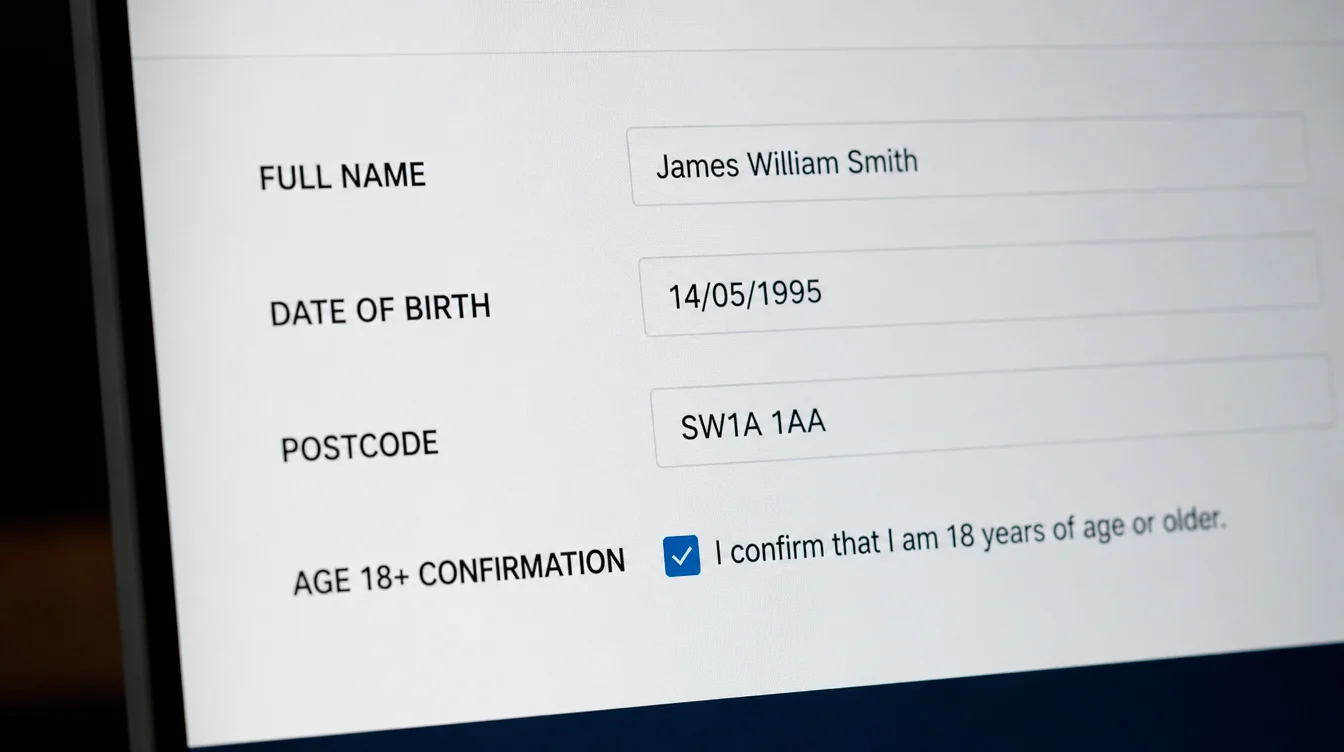
The eligibility clause is typically the first substantive section of the T&C document. It defines who can claim the welcome offer. The standard formulation requires the player to be a UK resident, aged 18 or over, with a single registered account at the operator. The clause references the operator’s standard age verification, which runs against government records during the registration KYC.
The complications in the eligibility clause come from three subclauses. First: the household exclusion. The standard “one bonus per household” rule blocks multiple welcome offer claims from the same registered address or shared device, even where the registrants are distinct individuals. Second: the prior account exclusion. Players who have previously held an account at the operator or any operator in the same group are typically blocked from the welcome offer, even if the prior account claimed no bonus. Third: the geographic exclusion. Some welcome offers exclude players from specific UK postcodes — typically Northern Ireland, Channel Islands, or Isle of Man postcodes — for operator-specific licensing reasons.
The clause that surprises most often is the one excluding players who have previously self-excluded via GamStop and whose exclusion period has ended. Some operators apply a 12-month cooldown post-exclusion before the welcome offer pathway re-opens, even after the formal exclusion has expired. The cooldown is not regulatory — it sits at the operator’s discretion — and it is rarely flagged outside the eligibility section of the T&C document.
The opt-in and qualifying-action clause
The opt-in clause defines how the welcome offer is activated. Three structures are common. Automatic credit on qualifying deposit — the most common in 2026, where the bonus credits on first qualifying deposit without any additional player action. Manual opt-in via a checkbox or code — typically used on offers tied to a specific promotional campaign. Code entry at deposit — used on offers triggered by a specific promotional code rather than by the standard qualifying deposit alone.
The qualifying-action specification is regulatory rather than operator-specific. Under the Social Responsibility Code 5.1.1(3b) that took effect on 19 January 2026, the qualifying action for a casino welcome bonus must be a casino-specific action. A casino bonus cannot be triggered by a sportsbook stake, even at an operator running both products on the same licence. The clause is universal across UK-licensed operators in 2026 and reflects the cross-product bundling ban.
The clause language to read carefully. The minimum qualifying deposit figure. The qualifying-action window — typically 7 to 14 days from registration. The promotional code or opt-in checkbox requirement, if any. Operators occasionally include a subclause requiring the player to be opted into marketing communications to qualify for the welcome offer, which is enforceable as a contractual condition but can be reversed by the player after the bonus credits without forfeiting the offer.
The wagering clause
The wagering clause is the most consequential single clause in the T&C document. It specifies the wagering multiplier, the wagering base, and the cumulative turnover required to clear the bonus. The 10x cap that took effect on 19 January 2026 limits the multiplier to 10x bonus value across UK welcome offers. Most operators sit at the cap; some sit below it. The clause that costs the most is the wagering requirement.
The wagering base matters as much as the multiplier. The standard 2026 structure applies the multiplier to bonus credit alone — “10x bonus” or “wagering on bonus” — producing a cumulative turnover of 10 times the bonus credit. The alternative structure applies the multiplier to deposit plus bonus — “10x D+B” or “wagering on deposit and bonus” — producing roughly double the cumulative turnover figure. The two structures look similar in headline terms but produce materially different player economics.
The clause language varies. Common phrasings include “wagering requirement of 10x bonus”, “10x rollover on bonus”, “playthrough of 10x bonus value”, and “turnover requirement of 10 times the bonus”. All four describe the same mechanic. The deposit-plus-bonus variant uses parallel phrasings — “10x deposit and bonus”, “10x D+B rollover” — and is structurally distinct from the bonus-only variant.
The clause also typically specifies the activation window for the wagering — the period during which the cumulative turnover must be completed. The standard 2026 window is 14 to 30 days, with 30 days the modal figure. The clock typically starts at bonus credit, not at qualifying deposit, which gives the player slightly more time than a casual reading might suggest. The implication of failing to complete within the window is the forfeiture of the bonus credit and any winnings derived from bonus play.

The maximum bet clause
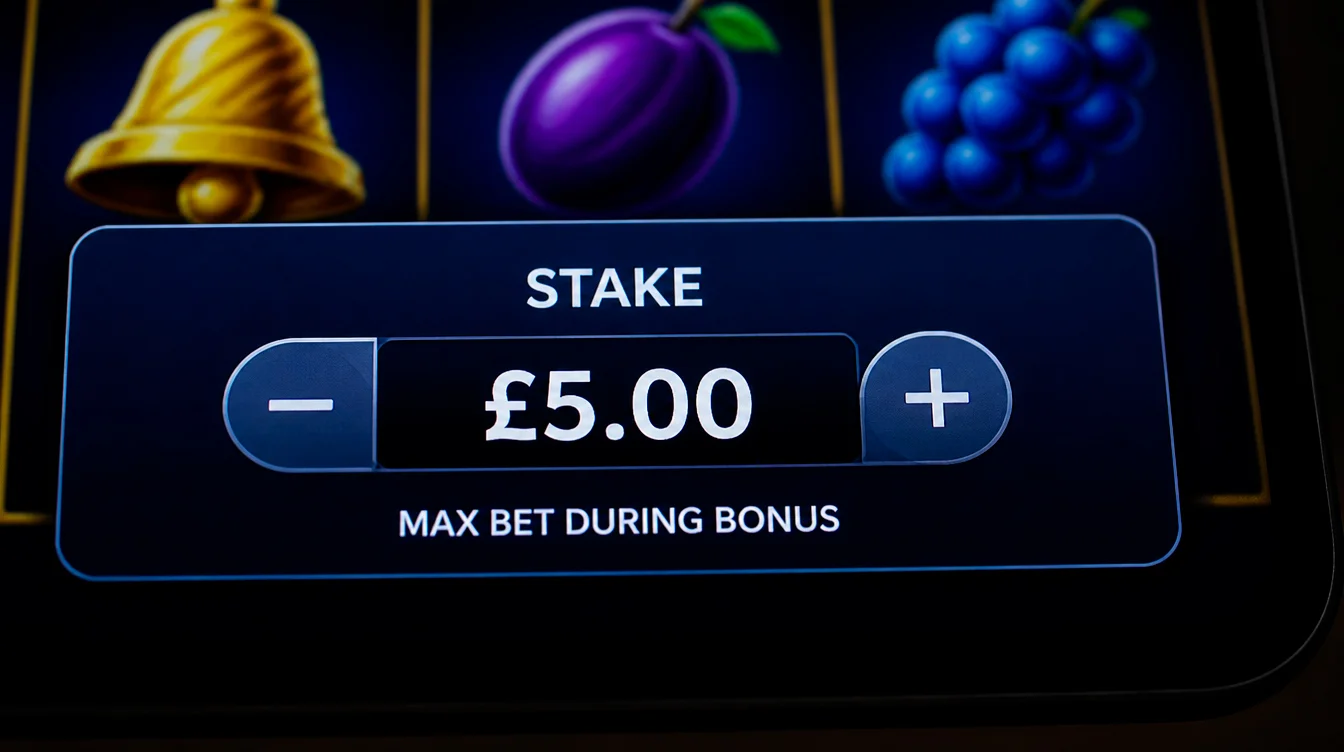
The maximum bet clause specifies the per-spin or per-hand stake cap that applies during the active-bonus window. The regulatory floor is £5 across the UK market, but some operators apply tighter caps — typically £3 or £4 on the highest-volatility slots, or £5 across the board with no exceptions.
The enforcement of the clause varies by game category. On slots, the cap is typically enforced through a real-time stake block — a stake above the cap is rejected or automatically reduced before the spin executes. On live tables, the cap is enforced through a post-hand compliance review, with bonus and winnings voided retroactively if the cap is breached. The two enforcement modes produce functionally identical outcomes for the player but the failure modes look different.
The clause language to read carefully includes the threshold figure, the enforcement game list, and the consequences of a breach. The standard consequence is forfeiture of the bonus credit and any winnings traced to bonus play — the player retains the original deposit but loses the bonus pathway. A small number of operators include a “first breach forgiveness” subclause that allows one inadvertent breach to be reversed without forfeiture, but this is the exception rather than the rule.
The clause matters most for players who routinely play higher stakes outside the bonus window. The £5 cap during the active-bonus window can feel restrictive, and the temptation to nudge above it is real. The consequence of a single breach is the loss of the entire bonus tranche, which on a fully-completed wagering position can be a several-hundred-pound mistake on a single stake.
The game eligibility and contribution clause
The game eligibility clause defines which games count toward the wagering requirement and at what contribution rate. The clause typically appears in the T&C tail as a table — game category in one column, contribution percentage in the other. The standard 2026 table runs roughly as follows. Slots 100%, with named exclusions for progressive jackpot slots, specific high-RTP titles, and certain provider catalogues. Video poker 50% with named exclusions. Electronic table games 25%. Live casino games 10%, with some game shows weighted at 25% or 50%.
The named exclusions matter as much as the headline weightings. A welcome offer with “slots 100%” but excluding 30% of the operator’s slot catalogue — including most of the highest-RTP titles — produces materially worse player economics than the headline weighting suggests. The exclusion list is typically located in the same T&C section as the contribution table but can run to several pages of game names. A careful reader checks whether their preferred slots are on the eligible list before committing to the offer.
The contribution weighting interacts with the wagering requirement to determine the effective cumulative turnover required from a specific game category. A £200 bonus at 10x wagering produces £2,000 of headline turnover. On 100% slot contribution this is £2,000 of slot spins. On 10% live casino contribution this is £20,000 of live casino stake. The difference is roughly the full house edge differential between the two product categories, but the apparent gap on the contribution table is much larger than the underlying economic differential implies. The mechanics of how game weighting interacts with the headline wagering figure are explored in detail elsewhere on the site.

The maximum cash-out cap clause
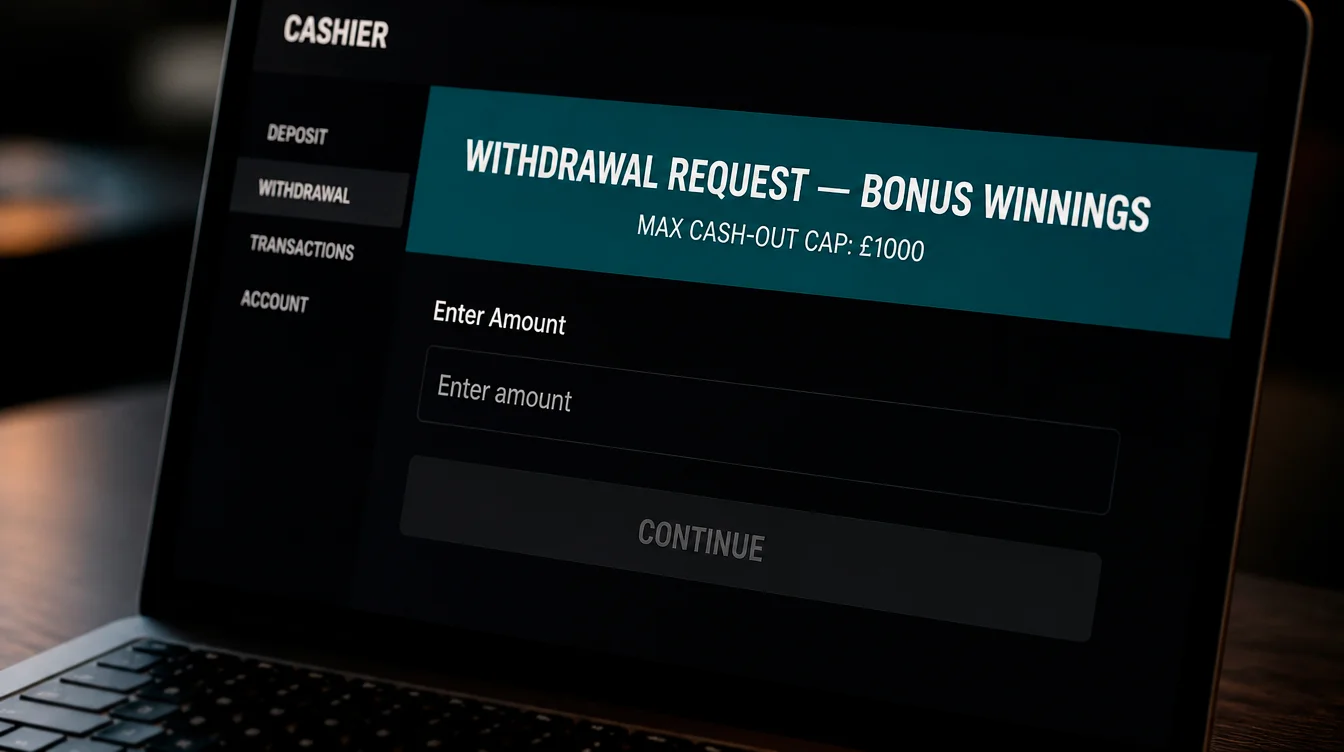
The maximum cash-out cap clause limits the absolute amount that can be withdrawn from the bonus-derived portion of the player’s balance. A typical 2026 welcome offer carries a maximum cash-out cap of £500 to £1,000 — capping the upside of any bonus-derived winnings regardless of how the wagering plays out.
The cap binds only on upside-variance outcomes. The standard expected value of a 10x wagering bonus at the mid-market house edge is around 60% of bonus credit, well below typical cap levels. The cap matters most on bonus claims that hit large slot wins during the wagering period — the small but non-trivial probability of converting a £150 bonus into a multi-hundred-pound balance through a single high-multiplier slot hit. The cap removes the long-tail upside from the distribution.
The clause language to read carefully includes the cap figure, the calculation basis, and the treatment of non-bonus funds. The cap typically applies to bonus-derived funds only — winnings from non-bonus play, where the operator can distinguish them, are not subject to the cap. The distinction is often difficult to maintain in practice and operators frequently apply the cap to the combined balance, which produces a less favourable outcome for the player.
The expiry and forfeiture clause
The expiry clause defines when the bonus credit and any associated wagering progress lapse. The standard structure runs across two timestamps. The activation expiry — the period during which the qualifying deposit must be made to trigger the offer, typically 7 to 14 days from registration. The wagering expiry — the period within which the cumulative turnover must be completed, typically 14 to 30 days from bonus credit.
The forfeiture mechanics on expiry. The bonus credit and any unconverted portion of the wagering progress are lost. The original deposit and any winnings derived from non-bonus play are retained. The player’s account remains active for normal play but the welcome offer pathway is closed. The forfeiture applies even on cases where the wagering progress is at 95% or higher — the deadline is absolute and partial completion does not preserve any bonus value.
The Casinomeister position on expiry windows captured a common player concern. The 10x cap on paper still means a grind if popular games are excluded or contribute marginally — the same principle applies to the expiry window. A 14-day wagering expiry on a £500 bonus at 10x produces £5,000 of cumulative turnover within 14 days, or roughly £357 per day. Achievable but not trivial. A 30-day expiry on the same bonus produces a much more comfortable pace. The clause language to look for is the wagering expiry figure and the clock-start event.

The bonus abuse clause
The bonus abuse clause is the operator’s defence against patterns of play that exploit the welcome offer structure in ways the operator did not intend. The clause typically reserves the operator’s right to void the bonus and any associated winnings if the operator determines that the player has engaged in bonus abuse.
The clause language is broad by design. Bonus abuse is typically defined to include multiple account creation, coordinated play across accounts, deliberate exploitation of game probabilities, and “any other behaviour that the operator considers to constitute abuse”. The breadth of the definition gives the operator wide discretion, and the discretion is exercised case-by-case rather than against a fixed rule set.
The Alun Bowden characterisation of the broader reform package captures the friction. The reforms were sweeping but unspecific in places, likely to cause chaos for cross-sell promotions and products — and the bonus abuse clause is one of the residual places where unspecific language gives the operator material flexibility. The clause has been used to void bonuses for patterns ranging from clearly abusive (multiple accounts, deliberate stake-coordination) to genuinely ambiguous (low-variance play designed to clear wagering without engaging with the operator’s preferred product).
The player’s recourse against a bonus abuse void is the operator’s complaints procedure followed by escalation to the operator’s licensed alternative dispute resolution provider. The escalation path is mandatory under the operator’s licence conditions, and the ADR process is independent of the operator. Successful escalations are uncommon but not unheard of. The mechanics of voiding and the typical grounds operators invoke are detailed in the welcome bonus voiding article that explains when operators pull the plug and what the player’s options are.
The withdrawal-restriction clause
The withdrawal-restriction clause limits the player’s ability to withdraw funds during the active-bonus window. The standard formulation prevents withdrawal of the qualifying deposit until the wagering requirement has been completed or the bonus has been formally forfeited. The clause is designed to prevent the player from depositing, claiming the bonus, and immediately withdrawing the deposit while retaining the bonus pathway.
The clause has two common variants. The strict variant ties the qualifying deposit to the bonus until wagering completes — a withdrawal attempt during the active-bonus window is rejected or processed only after explicit bonus forfeiture. The lenient variant allows withdrawal of the qualifying deposit but applies a forfeiture rule — the bonus is voided as a consequence of the withdrawal, and the player walks away with their deposit minus any losses but no bonus credit.
The clause does not affect non-bonus funds. A player who has accumulated winnings from non-bonus play during the active-bonus window can typically withdraw those funds without affecting the bonus pathway, subject to the operator’s ability to distinguish bonus from non-bonus funds on the account ledger. The distinction is often maintained by tagging the funds at the source — bonus-credited funds and their derivatives are tagged, qualifying-deposit funds and their derivatives are not. The tagging supports the withdrawal-restriction clause in practice but the tagging is rarely visible to the player.
The payment-method exclusion clause
The payment-method exclusion clause specifies deposit methods that do not qualify for the welcome offer. The standard 2026 list excludes Skrill, Neteller, and Paysafe. Some operators also exclude PayPal, though this varies. The exclusion is at the qualifying-deposit stage — a deposit via an excluded method does not trigger the welcome offer, even if the deposit amount and other conditions are satisfied.
The historical reason for the exclusion is anti-bonus-abuse. The wallets in scope were historically the primary vehicle for arbitrage-style bonus claims, where a single underlying card or bank account funded multiple welcome offer claims at different operators through wallet intermediaries. The exclusion broke the wallet-based laundering pathway and persists in 2026 as a near-universal industry standard, even though the underlying anti-abuse case has weakened with the introduction of stronger KYC infrastructure.
The clause language is usually located in the qualifying-deposit section of the T&C document, listing the excluded methods explicitly. The implication of using an excluded method is that the welcome offer pathway is closed for the qualifying deposit — the funds remain available as cash but the bonus does not credit. The pathway cannot be re-opened by switching to an eligible method on a subsequent deposit, because the welcome offer is treated as expended on the qualifying-deposit transaction regardless of the bonus outcome.

The reading order that works in practice
A ten-minute T&C read in 2026 should run through the clauses in this order. First: the eligibility clause, to confirm the player can claim the offer at all. Second: the qualifying-action clause, to confirm the deposit and product requirements. Third: the payment-method exclusion clause, to confirm the deposit method is eligible. Fourth: the wagering clause, to extract the multiplier and the wagering base. Fifth: the game eligibility and contribution clause, to identify the eligible games list and the contribution weightings. Sixth: the maximum bet clause, to confirm the per-spin cap during play. Seventh: the maximum cash-out cap clause, to identify the upper limit on withdrawal. Eighth: the expiry clause, to confirm the activation and wagering windows. The remaining clauses — bonus abuse, withdrawal restriction, account closure — are worth scanning but rarely change the offer’s central economics.
The reading produces a structured understanding of the offer that the marketing page does not provide. The headline number is one input; the full set of clauses determines what the headline actually delivers. The market in 2026 includes welcome offers where the headline and the clause set align cleanly — the offer is exactly what the marketing page implies. It also includes offers where the headline and the clause set diverge materially — the offer’s actual expected value or completion probability is meaningfully different from what a headline-only read would suggest. The T&C document is the only reliable way to distinguish the two cases before depositing.
Which T&C clauses are most likely to surprise a first-time welcome bonus claimant?
The game eligibility and contribution clause is the most common source of surprise — the eligible-games list can be much narrower than the headline implies, and the contribution weighting on table games and live casino significantly increases the effective wagering requirement. The maximum cash-out cap is the second most common, particularly on smaller welcome offers where the cap can bind on upside-variance outcomes. The payment-method exclusion clause is third — many players use Skrill or Neteller by default and are surprised when the bonus does not credit on their qualifying deposit.
Can the operator change the T&Cs of a welcome offer after I’ve claimed it?
The operator can change the T&Cs going forward but cannot retroactively apply new terms to an already-claimed offer. The wagering requirement, eligible games list, maximum bet rule, and expiry windows in effect at the moment of bonus credit govern the offer through its completion. A subsequent T&C amendment applies only to bonuses claimed after the amendment effective date.
What is the difference between bonus abuse and ordinary advantage play under the T&Cs?
Bonus abuse is typically defined in the T&Cs to include multiple account creation, coordinated play across accounts, deliberate exploitation of game probabilities, and similar patterns. Ordinary advantage play — selecting high-RTP games within the eligible list, managing stake size to minimise variance, completing wagering efficiently — is not bonus abuse under any reasonable reading. The line between the two can be ambiguous on edge cases, which is part of why the bonus abuse clause is written broadly and applied case-by-case.
Are the T&Cs of a UK welcome bonus enforceable against the player in court?
The T&Cs are contractual terms that govern the relationship between the player and the operator. They are enforceable subject to general UK contract law, which includes provisions against unfair contract terms and requires terms to be drawn to the player’s attention before the contract is formed. The complaint and dispute resolution path runs first through the operator’s internal complaints procedure and then through the operator’s licensed alternative dispute resolution provider, with court action available as a residual route in rare cases.
This material was created by the WagerVane team.
Related posts
Casino Welcome Bonus Withdrawal: From Wagering Clear to Bank Account

Live Casino Welcome Bonus UK: Why Dealer Tables Are Usually Excluded