Casino Welcome Bonus Wagering Requirements: The UK Mechanics in 2026
 Available in GB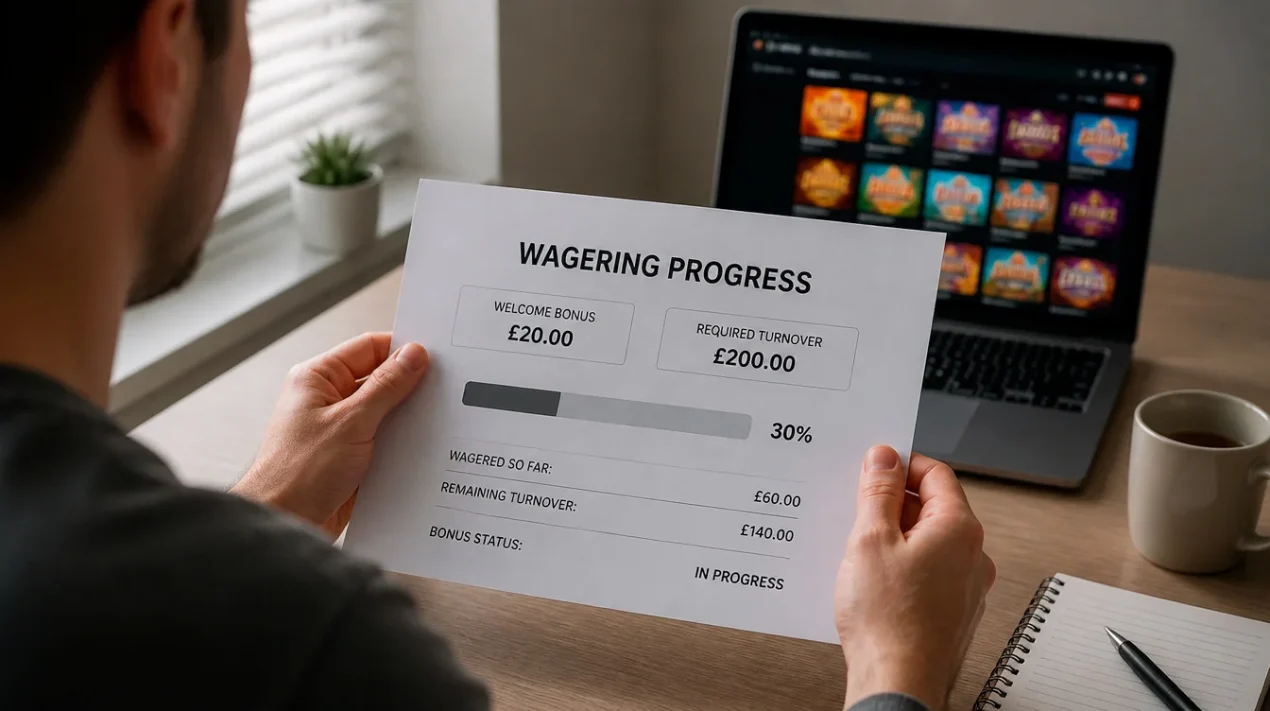
The clause that determines whether a welcome bonus is worth claiming
The wagering requirement is the single most consequential clause in any UK casino welcome bonus. Every other clause — the cap, the maximum bet rule, the game weighting, the activation window — affects the player’s expected value at the margins. The wagering requirement defines the central economics. Get the wagering requirement wrong on a welcome offer and the entire offer is the wrong colour, regardless of how the headline looks.
I have spent more time explaining wagering requirements to first-time depositors than any other aspect of welcome bonus mechanics. The reason is structural. The clause requires the player to bet some multiple of the bonus credit before the bonus converts to withdrawable funds. The arithmetic is straightforward but the implications are not. A 10x wagering requirement on a £100 bonus means £1,000 of cumulative bets. That figure surprises people the first time they encounter it, and the surprise persists across repeat exposures because the cumulative figure is rarely the number the marketing material leads with.
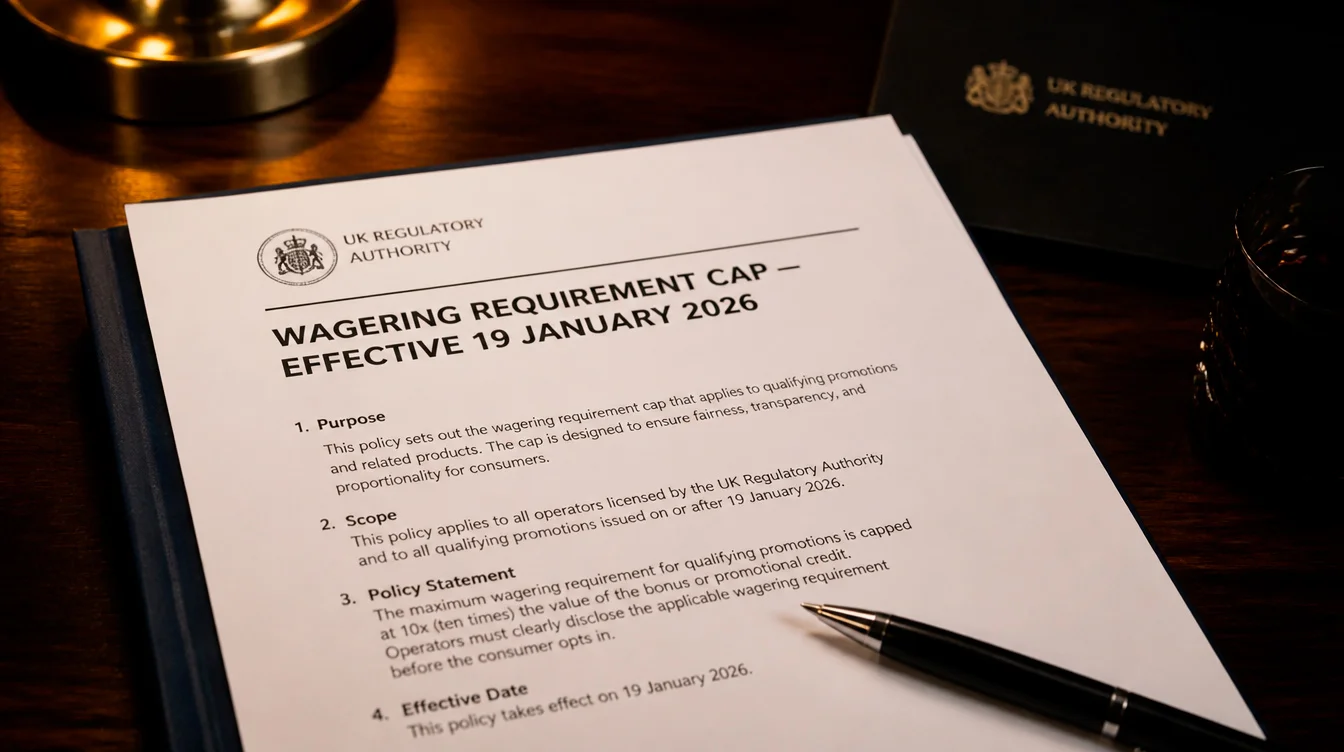
The wagering requirement on UK welcome bonuses has undergone the largest single change in its history this year. The Social Responsibility Code 5.1.1, which took effect on 19 January 2026, capped welcome bonus wagering at 10x bonus value across the UK-licensed market. The cap halved or thirded the typical wagering requirement at most operators overnight. This piece walks through what the wagering requirement actually means in 2026, how the cap reshaped the economics, and what the practical implications are for any player approaching a welcome offer page. The full picture is in our guide to the UK casino welcome bonus.
The pre-cap landscape and how it shaped expectations
The standard UK welcome bonus wagering multiplier through most of 2024 and the first part of 2025 ran at 35x bonus value. A 100% match capped at £200 with 35x wagering generated £7,000 of cumulative turnover required to clear. At a 4% house edge on standard slots — the mid-market RTP assumption for the eligible-for-bonus universe — the expected drain across that turnover was £280. The bonus credit was £200. The expected value of the offer to the player was £200 minus £280, a net negative figure of around minus £80 per £200 deposit.
The pre-cap welcome bonus was, on average, a negative expected value product for the player. The marketing emphasised the headline match and the bonus credit; the wagering requirement turned the headline into a structural loser for any player completing the wagering at the average house edge. The offers worked commercially because completion rates were low — many players did not complete the wagering — and because the players who did complete tended to be self-selected for higher engagement and higher subsequent deposit volume. The economics of the offer landed in the operator’s favour through completion friction, not through generosity.

The Casinomeister position on the pre-cap structure captured the player advocacy concern at the time. The 10x cap on paper still means a grind if popular games are excluded or contribute marginally, which articulated the fundamental issue: the headline wagering multiplier was only one of several mechanisms that determined the actual cost to the player, and capping the multiplier without addressing the other mechanisms would leave the underlying friction in place. The Gambling Commission’s response to this concern was the broader package of reforms that took effect alongside the cap.
What changed on 19 January 2026
The Social Responsibility Code provision 5.1.1 limits welcome bonus wagering requirements to 10x bonus value across the UK-licensed market. The cap is a hard ceiling — operators cannot apply a higher multiplier on a welcome offer regardless of operator type, deposit size, or product. The cap applies to the bonus value as the wagering base, not to a deposit-plus-bonus structure, which materially narrows the room for operators to recover the wagering volume through structural workarounds.
The Gambling Commission’s framing of the cap in the March 2025 consultation response described it as reducing the likelihood of harm, reducing complexity, and improving transparency while maintaining consumer choice. The framing reflects the regulatory reasoning, which combined three concerns. First, high wagering multipliers obscured the actual cost of the bonus to the player, making informed consumer choice difficult. Second, the cumulative turnover required at multiples above 10x produced play patterns that elevated harm risk. Third, the complexity of the calculation acted as a barrier to comparison shopping across offers, distorting competitive dynamics in favour of operators with the most aggressive multipliers rather than the most generous net offers.
The cap converted the standard welcome bonus from a negative-expected-value product to a positive-expected-value product at the mid-market house edge assumption. The same 100% match capped at £200 with 10x wagering now produces £2,000 of cumulative turnover and £80 of expected drain at 4% house edge. The expected value flips from minus £80 to plus £120. This is the largest single change to the welcome bonus economics in the history of the UK regulated market.
The mechanics of the cumulative turnover calculation
The wagering calculation runs on a single formula. Cumulative turnover required equals bonus credit times wagering multiplier. A £150 bonus at 10x wagering produces £1,500 of cumulative turnover. A £200 bonus at 10x wagering produces £2,000. A £50 bonus at 5x wagering produces £250. The formula is mechanical and the inputs are usually disclosed prominently on the welcome offer page.
The cumulative turnover is the total of all bets placed during the active-bonus window, summed across each spin or hand. A player who bets £2 per spin and plays 1,000 spins has accumulated £2,000 of turnover, regardless of whether the spins won or lost. The cumulative figure does not net wins against bets — wins increase the player’s balance and become available for further bets that add to the cumulative figure. The turnover meter ticks forward on every bet placed and ignores the outcome.

The contribution weighting modifies the turnover calculation at the game-by-game level. Slots typically contribute at 100% — £1 bet equals £1 of wagering progress. Table games contribute at 10% to 25% — £1 bet equals 10p to 25p of progress. Live casino typically contributes at 10% or is excluded entirely. The weighting structure means that the headline turnover figure of £2,000 on a £200 bonus at 10x can require £20,000 of actual live blackjack stake to clear if the contribution rate is 10%. The weighting matters as much as the headline multiplier for any player not playing the highest-contribution games. What counts towards it: game weighting.
The eligible-games list adds a further modifier. Some games are excluded entirely from wagering eligibility, contributing 0% regardless of weighting. The standard exclusions in 2026 include progressive jackpot slots, certain high-RTP titles, and a varying selection of live casino tables. The exclusion list typically sits in the T&C tail rather than on the marketing page, and an offer that looks attractive at the headline can become difficult to clear if the player’s preferred games sit outside the eligible list.
The interaction with deposit-versus-bonus wagering structures
The wagering base is one of the most consequential structural choices in a welcome bonus design. Two common bases exist. The bonus-only base applies the multiplier to the bonus credit alone — a £200 bonus at 10x requires £2,000 of turnover. The deposit-plus-bonus base applies the multiplier to the sum of the deposit and the bonus — a £200 deposit plus a £200 bonus at 10x requires £4,000 of turnover.
The two bases produce materially different player economics. The bonus-only base is the standard in 2026, partly because the regulatory framing of the cap explicitly references bonus value as the wagering base. The deposit-plus-bonus base persists at a minority of operators but has become rarer through 2026 as the standard structure has consolidated. A player encountering a deposit-plus-bonus structure on a welcome offer should read the multiplier as effectively double what it appears to be on first reading — a 10x multiplier on deposit-plus-bonus is structurally equivalent to a 20x multiplier on bonus only, with corresponding implications for the expected value calculation.
The clause language to look for differs between the two structures. The bonus-only structure typically reads “wagering on bonus” or “10x bonus value”. The deposit-plus-bonus structure typically reads “wagering on deposit plus bonus” or “10x D+B”. The T&C document is the authoritative source, and the structure is invariably disclosed even if it is not foregrounded on the marketing page.
The bonus expiry window and the rate of completion
The wagering requirement runs against a clock. The standard UK welcome bonus carries a 14 to 30 day expiry on the wagering completion, with 30 days the most common figure in 2026 and 14 days more common at operators that have tightened activation windows in response to the duty rise. The clock starts at the moment the bonus credits, which on most accounts is the moment of qualifying deposit clearance.
The expiry window interacts with the cumulative turnover requirement to define a required pace of play. A £200 bonus at 10x wagering with a 14-day expiry requires £2,000 of turnover within 14 days, or roughly £143 per day. At a £2 average stake, that translates to roughly 71 spins per day. Average UK slot session length in the October to December 2025 quarter ran to 16 minutes with 124 spins per session — a single average session would cover almost two days of required pace. The 14-day window is comfortably achievable on the standard offer with regular play.

The pace becomes tight on larger bonuses or shorter windows. A £500 bonus at 10x wagering with a 14-day expiry requires £5,000 of turnover, or roughly £357 per day. At £4 average stake — close to the maximum bet rule ceiling — this is 89 spins per day, around 12 minutes of slot play per day at the average UK session pace. Achievable but no longer trivial, especially for players who do not play every day.
The behavioural data on session length and intensity matters here. The October to December 2025 quarter recorded online slot gross gambling yield of a record £788 million, up 10% year-on-year, even as the share of sessions longer than one hour fell from 6.2% to 4.4% and average session length declined from 18 minutes to 16. The market has grown in aggregate while per-session intensity has moderated. The combined pattern means that welcome bonus completion rates depend more on the activation window calibration than on the cumulative turnover figure — a tight window penalises players whose session pattern is short and infrequent.
The maximum bet rule and the rate of clearance
The £5 maximum bet rule applies across the active-bonus window. The rule prevents the wagering requirement from being cleared rapidly through high-stake play, which would expose the operator to high-variance outcomes on the bonus tranche and would, from the regulator’s perspective, increase harm risk for players using the bonus as a vehicle for high-stake speculation.
The rule is structurally tied to the wagering requirement calculation. A £200 bonus at 10x produces £2,000 of cumulative turnover. At the £5 cap, the minimum number of bets required to complete the wagering is 400 — assuming every bet is at the maximum. At a more realistic £3 average stake, the number of bets is 667. The rule ensures that the wagering window has a non-trivial floor on the number of betting actions required, regardless of stake size.

The enforcement of the £5 rule varies by game category. On slots, the rule is enforced through a real-time stake cap — a stake set above £5 is rejected or automatically reduced before the spin executes. On live tables, the rule is enforced through a post-hand compliance check, with bonus and winnings voided retroactively if the cap is breached. The two enforcement modes produce functionally identical outcomes — the player cannot extract bonus value from stakes above the cap — but the failure modes look different. The full mechanics of how the £5 cap intersects with game category and contribution weighting are walked through in detail in the game weighting article that breaks down the contribution table and the effective wagering requirement on each game category.
What the cap did to the operator economics
The operator response to the 10x cap has worked through three channels. First: cap reductions on the bonus credit. A standard 100% match that ran to a £200 cap pre-implementation now commonly runs to a £150 cap, with some operators dropping to £125. The headline match percentage is intact but the absolute bonus value has dropped by 20% to 35%.
Second: tighter game eligibility. The highest-RTP slots — typically 97% to 98% RTP titles — have been removed from the eligible-for-wagering universe at the majority of operators. The eligible list now skews toward 94% to 96% RTP titles, with an effective house edge of roughly 4% to 6% across the modal eligible game. The shift raises the effective expected drain on the wagering turnover and partially recovers the operator margin lost to the lower multiplier.
Third: shorter activation windows. Some operators have reduced the activation window from 14 days to 7, and the bonus expiry window from 30 days to 21. The change reduces the operator’s exposure on the open bonus tranche and lowers completion rates at the margins, which feeds back into the per-bonus economics.
The combined effect on operator economics has been a partial offset to the cap impact. The pre-cap economics on a typical welcome offer ran on completion rates of 30% to 40% at high wagering multiples, with operator margin recovery happening primarily through the non-completing 60% to 70% of claimants. The post-cap economics run on completion rates of 60% to 70%, with the per-completion margin much lower but the volume of completions much higher. The structural shift means that the welcome bonus is a more transparent product on average but a less profitable one per claim for the operator, with the operator’s commercial response showing up in the cap reductions and game weighting changes described above.

The Remote Gaming Duty layer and what it added
The Remote Gaming Duty rose from 21% to 40% on 1 April 2026, two and a half months after the wagering cap took effect. The combined effect on operator economics was sharp, and the welcome offer page absorbed most of the adjustment through further cap reductions and game weighting tightening on top of the changes already made in response to the cap.
The arithmetic on the duty rise. Operator gross gambling yield from a £200 bonus at 10x wagering on slots at 4% house edge is £80. Pre-rise duty at 21% was £16.80. Post-rise duty at 40% is £32. The duty alone removed £15.20 of contribution per bonus from the operator’s economics. The cap reduction from £200 to £150 on a 100% match removed £50 of operator exposure per fully-converted bonus. The combined effect — duty rise plus cap reduction — broadly preserved per-bonus operator economics while shifting the bonus value downward by 25% in cap terms.
The combined effect of the 2025-26 changes on player expected value runs in opposite directions. The wagering cap pushed expected value up substantially. The duty rise and the subsequent cap and weighting changes have pushed it down by a smaller absolute amount. The net is a market where welcome offers are more uniformly positive expected value than they were in 2024, but the average gross expected value on a standard offer is below the 2025 peak.

The practical wagering question for a 2026 welcome bonus
A player approaching a UK welcome bonus in 2026 needs to do one calculation reliably. Bonus credit times wagering multiplier equals cumulative turnover. The figure should be compared against the player’s realistic ability to complete it within the activation window, given their typical stake size and play frequency.
The reference points. A £150 bonus at 10x produces £1,500 of cumulative turnover, achievable in 6 to 10 hours of slot play at standard pace. A £200 bonus at 10x produces £2,000 of cumulative turnover, achievable in 8 to 14 hours. A £500 bonus at 10x produces £5,000 of cumulative turnover, achievable in 20 to 35 hours — meaningful play across the standard 30-day window but well within the limits of a regular player’s monthly engagement.
The figures scale to deposit size and the player’s typical play volume. The wagering requirement on a 2026 UK welcome bonus is no longer the structural problem it was in 2024 — the cap has converted the offer into a positive-expected-value product across the standard parameter ranges — but the wagering requirement is still the largest single time and effort cost the player accepts in exchange for the bonus. The calculation is worth doing before depositing, not after.
The wagering requirement is also the clause most affected by future regulatory and tax changes. The 10x cap is regulatory and is unlikely to move further downward in the next twelve months — the implementation is recent and the regulator’s attention has shifted to monitoring outcomes. The eligible games list and the contribution weightings can shift more freely and are likely to do so as operators continue to calibrate post-duty economics. The wagering requirement is structurally locked in. The mechanics that determine how easy it is to complete are not.
Why did the UK Gambling Commission set the wagering cap at 10x specifically?
The 10x figure emerged from the March 2025 consultation as the threshold that the Commission described as reducing the likelihood of harm, reducing complexity, and improving transparency while maintaining consumer choice. The figure represents a roughly three-and-a-half-fold reduction from the pre-cap norm of 35x and produces wagering arithmetic that is meaningfully more transparent to a player calculating expected value before depositing.
Does the 10x cap apply to all bonuses or only welcome bonuses?
The 10x cap applies to welcome bonuses across UK-licensed operators. Reload bonuses, cashback offers, and other post-welcome promotions are subject to the same Social Responsibility Code framework but the regulatory clarity on these wider promotional structures is still being established. The welcome bonus is the most explicit application of the cap and the most consistently enforced across the operator population.
Can a UK operator use a deposit-plus-bonus wagering structure under the 10x cap?
The cap is written against bonus value, and the dominant 2026 implementation applies the multiplier to bonus credit alone. A deposit-plus-bonus structure can comply with the cap but the effective wagering on the deposit portion typically reduces to 1x with the bonus portion at 10x, producing a similar overall turnover figure. The structure is rare in 2026 because the bonus-only base reads more cleanly under the new cap.
What happens to my wagering progress if the bonus expires before I complete it?
The bonus credit and any unconverted portion of the wagering progress are forfeited on expiry. The player’s original deposit and any winnings derived from non-bonus play remain available for normal play or withdrawal. The wagering progress accumulated up to the moment of expiry does not carry forward to subsequent bonus claims at the same operator.
This material was created by the WagerVane team.
Related posts

Casino Welcome Bonus Withdrawal: From Wagering Clear to Bank Account

Live Casino Welcome Bonus UK: Why Dealer Tables Are Usually Excluded