Casino Welcome Bonus Expected Value: The 2026 UK Framework
 Available in GB
The number that should sit behind every welcome offer comparison
The first time I tried to explain expected value to someone considering a welcome bonus, I made the mistake of leading with the formula. The conversation got stuck on terminology — what “expected” meant in a context that was clearly probabilistic, why we were subtracting something from the bonus, what the house edge actually was. The second time I tried, I led with the answer. The expected value of a typical UK welcome bonus in 2026 is around £90 to £120 on a standard 100% match capped at £150 to £200. Positive. Worth claiming if the player intends to clear the wagering. From that starting point, the formula made sense as the way of arriving at the answer rather than as the answer itself.
Expected value is the single most useful concept for evaluating a welcome bonus. It collapses the relevant variables — bonus credit, wagering requirement, house edge, game eligibility, completion probability — into a single comparable number. The number is not precise. It is a central estimate around a distribution with meaningful spread, and the spread matters in any individual case. But for comparing across welcome offers, ranking offers consistently, and deciding whether to claim an offer at all, the expected value figure is the most useful summary statistic available.
This piece walks through the expected value framework as it applies to UK welcome bonuses in 2026. The arithmetic of the central calculation. The variables that go into it. The structural changes in the 2025-26 regulatory and tax environment that have moved the central number. The completion probability adjustment that matters for risk-adjusted expected value. And the per-pound efficiency metric that complements absolute expected value for any player whose deposit size is itself flexible. The full picture is in our guide to the UK casino welcome bonus.
The basic expected value formula
The expected value of a welcome bonus to the player is the bonus credit minus the expected drain across the wagering turnover required to convert the bonus to withdrawable funds. The formula in three steps. First: cumulative turnover equals bonus credit times wagering multiplier. Second: expected drain equals cumulative turnover times effective house edge. Third: gross expected value equals bonus credit minus expected drain.
A worked example. £150 bonus at 10x wagering on standard slots. Cumulative turnover: £150 × 10 = £1,500. Expected drain at 4% effective house edge: £1,500 × 0.04 = £60. Gross expected value: £150 – £60 = £90. The bonus delivers, in expectation, £90 of withdrawable value on the assumption that the wagering completes. The expected drain is the cost of converting the bonus credit from operator-held wagering-bound funds to player-held withdrawable funds.
The formula captures the central economics of the offer but does not capture the variance around the expected value. The actual outcome on any individual welcome bonus claim is distributed around the £90 figure, with the standard deviation of the distribution depending on the variance profile of the eligible games. On standard slots the standard deviation across the £1,500 turnover is on the order of £150 — large enough that individual outcomes can range from substantially negative to substantially positive. The £90 figure is the average across many such claims, not a guaranteed return on any single claim.
The other variables that modify the central calculation are the game eligibility list, the maximum cash-out cap, the activation window, and the completion probability. Each enters the calculation as a multiplier or constraint on the central figure, and the integrated calculation produces a refined expected value estimate that captures more of the offer’s actual structure.

The 10x cap and what it did to the EV calculation
The Social Responsibility Code 5.1.1 amendment that took effect on 19 January 2026 capped wagering requirements at 10x bonus value across the UK-licensed market. The cap converted the standard welcome bonus from a negative expected value product to a positive one across the standard parameter ranges.
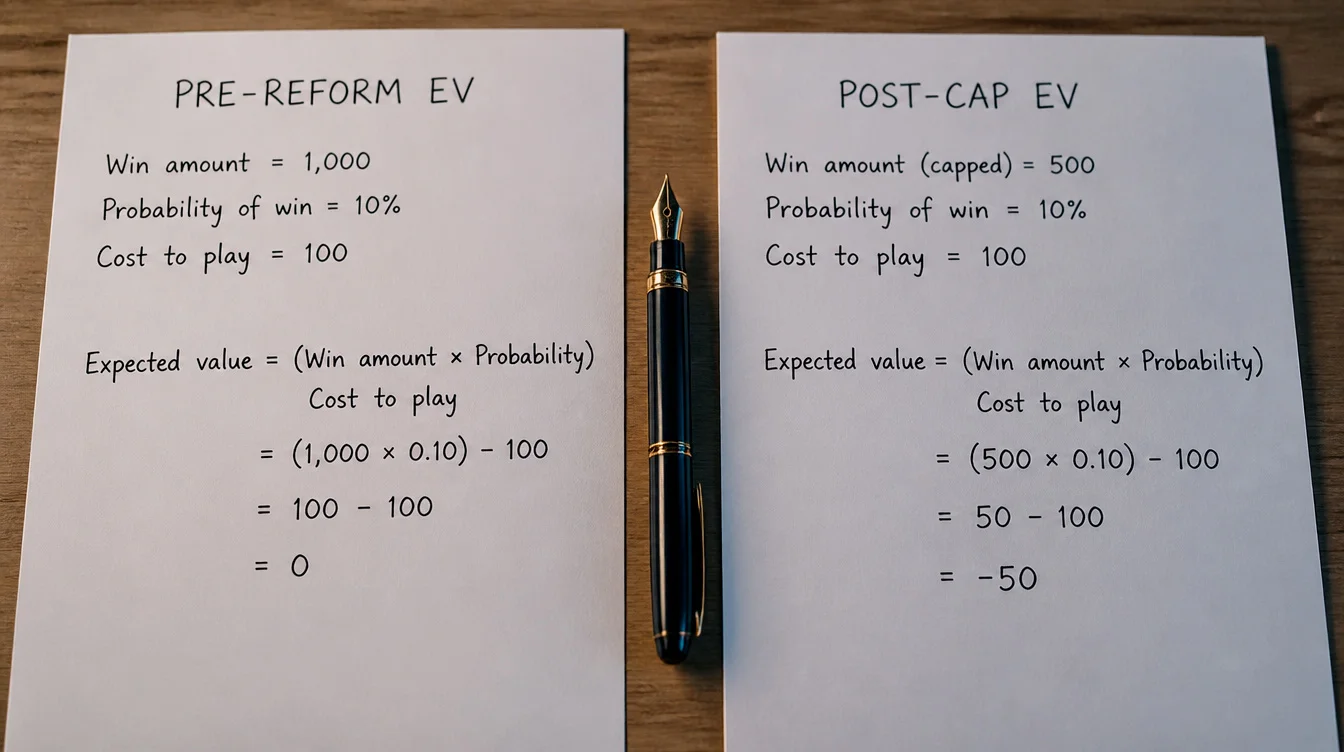
The pre-cap calculation, using the same worked example. £150 bonus at 35x wagering on standard slots. Cumulative turnover: £150 × 35 = £5,250. Expected drain at 4% effective house edge: £5,250 × 0.04 = £210. Gross expected value: £150 – £210 = negative £60. The standard welcome bonus under the pre-cap regime delivered, on average, negative expected value to any player completing the wagering at the mid-market house edge.
The Gambling Commission framing of the cap in the March 2025 consultation response described the measure as reducing the likelihood of harm, reducing complexity, and improving transparency while maintaining consumer choice. The framing addressed the underlying regulatory concern that high wagering multiples obscured the actual cost of the bonus to the player and produced play patterns inconsistent with informed consumer choice. The 10x cap was the structural response — a hard ceiling that produces wagering arithmetic transparent enough for a player to calculate expected value before depositing.
The implementation effect on expected value was the largest single shift in the welcome bonus market’s history. A standard offer at the modal pre-cap structure delivered around minus £60 of expected value per £150 bonus. The same offer post-cap delivers around plus £90. The £150 absolute swing per claim is, multiplied across the volume of welcome bonus claims at UK-licensed operators, a multi-hundred-million-pound transfer from operator to player on a steady-state expected basis.
The effective house edge and why it varies
The 4% figure used in the worked example is the mid-market assumption for the eligible-for-bonus slot universe at UK operators in 2026. The figure is an average across the standard eligible list and varies materially depending on the specific slots included in the eligibility universe at a given operator.
The underlying mathematics. House edge is the complement of return-to-player percentage. A slot with 96% RTP returns 96 pence of every pound staked, on average across infinite spins, with a 4% house edge. A slot with 94% RTP returns 94 pence per pound staked, a 6% house edge. A slot with 97% RTP returns 97 pence per pound staked, a 3% house edge. The RTP figures are typically disclosed in the slot’s information panel and vary from around 93% to 98% across the licensed UK market.
The 2026 welcome bonus eligibility lists tend to skew toward the lower-RTP end of the available range. The highest-RTP titles — typically 97% to 98% RTP slots — have been removed from the eligible-for-wagering universe at the majority of operators, partly in response to the operator margin compression from the wagering cap and the Remote Gaming Duty rise. The eligible list now sits around 94% to 96% RTP at most operators, with the modal RTP around 95% to 95.5% — an effective house edge of 4.5% to 5%.
The implication for the expected value calculation is that the 4% figure is moderately optimistic for the 2026 eligibility lists. A more realistic central estimate is 4.5% effective house edge, which on the £150 bonus at 10x produces £67.50 of expected drain and £82.50 of gross expected value. The shift from £90 to £82.50 is meaningful but not dramatic — the central conclusion that the standard 2026 welcome bonus is positive expected value remains intact, with the precise figure depending on the specific eligibility list at the operator.

The game weighting modifier
The contribution weighting on the wagering requirement adds a further dimension to the expected value calculation. The standard slot weighting at 100% allows the formula above to run unchanged. Non-slot weightings — typically 10% to 25% on table games and live casino — modify the effective turnover requirement and the resulting expected drain.
The calculation on a different game category. £150 bonus at 10x wagering, cleared on live blackjack at 10% contribution and 0.5% house edge. Headline cumulative turnover £1,500. Effective live blackjack turnover required to satisfy headline turnover: £1,500 ÷ 0.10 = £15,000. Expected drain on £15,000 of live blackjack stake at 0.5% house edge: £15,000 × 0.005 = £75. Gross expected value: £150 – £75 = £75.
The interesting result is that clearing the wagering on live blackjack produces a similar expected value to clearing on slots, despite the very different turnover figures. The contribution weighting and the underlying house edge differential broadly offset each other — the weighting drops the contribution rate by a factor of ten, the house edge differential drops by a factor of eight, and the resulting expected drain is in the same range. The structure is by design: the contribution weighting framework is calibrated to deliver similar operator economics across game categories, and the symmetric calibration produces similar player economics.
The exceptions are games where the weighting and the house edge differential do not line up neatly. Live roulette at 10% contribution and 2.7% house edge produces, on the same £150 bonus at 10x calculation: effective turnover £15,000, expected drain £405, gross expected value negative £255. The roulette case is much worse than the slot or blackjack case because the weighting penalises the game more aggressively than the house edge differential justifies. Three offers run through the formula: the worked examples.

The completion probability adjustment
The gross expected value figure assumes the wagering completes. In reality, a meaningful fraction of welcome bonus claims do not complete the wagering within the activation window, and the resulting expected value to non-completing players is zero on the bonus tranche.
The completion probability depends on three factors. The cumulative turnover required to complete — larger figures mean lower completion probability for any given player engagement pattern. The activation window — longer windows mean higher completion probability. The player’s typical play volume and pattern — players who play regularly and consistently complete at higher rates than players who play sporadically.
The pre-cap completion rates ran in the 30% to 40% range across the UK market on standard welcome offers. The cap implementation lifted completion rates to the 60% to 70% range by reducing the cumulative turnover requirement by roughly two-thirds. The rate sits at the higher end of this range on standard 14 to 30 day activation windows and the lower end on tighter 7-day windows.
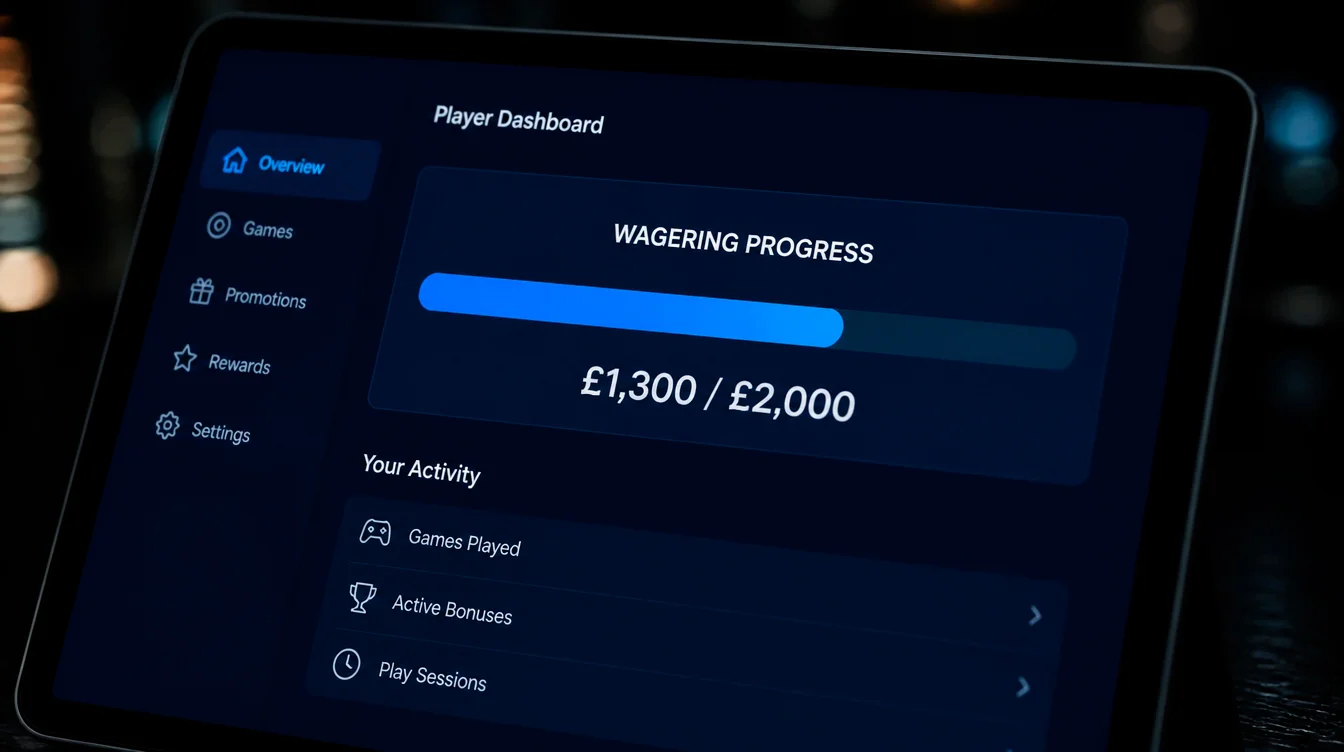
The risk-adjusted expected value calculation applies the completion probability as a discount on the gross figure. Gross expected value £90, completion probability 65%, risk-adjusted expected value £58.50. The risk-adjusted figure is the central planning estimate for a player who is not certain to complete the wagering; it captures the partial-completion risk that the gross figure ignores.
The completion probability is most useful as a player-specific input rather than a market-wide figure. A player whose typical pattern is regular daily play completes at higher rates than a player whose pattern is occasional weekend play. The same offer can deliver £90 of gross expected value to both players but a risk-adjusted value of £80 to the first and £45 to the second, depending on their individual completion probability. The right comparison across offers uses each player’s expected completion rate rather than a market-wide average.
The maximum cash-out cap and the long-tail truncation
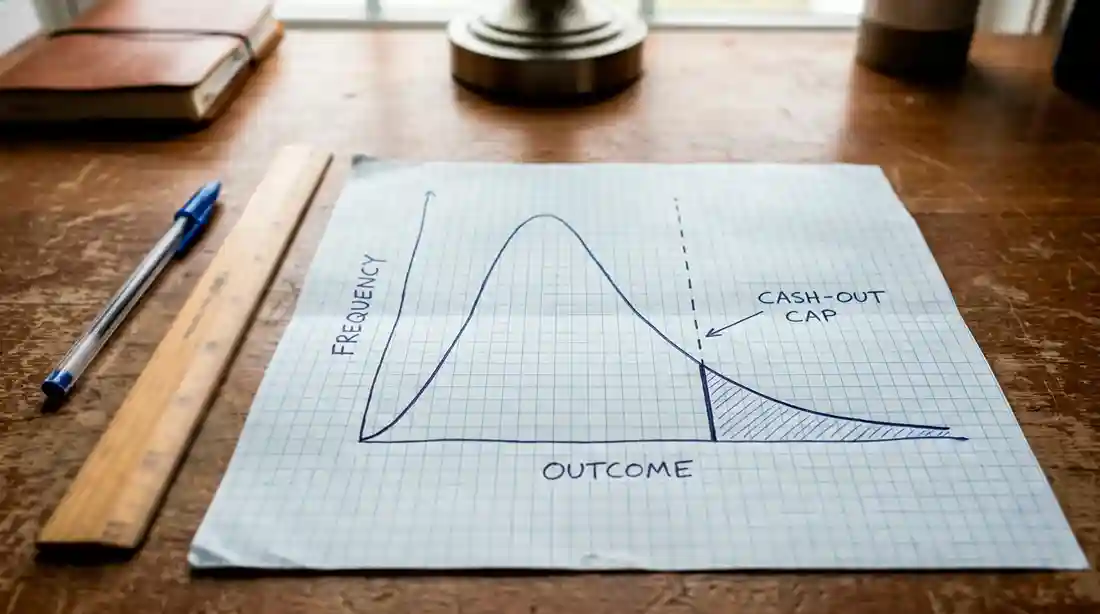
The maximum cash-out cap on a welcome bonus modifies the expected value calculation by truncating the long-tail upside of the distribution. The cap binds only on upside-variance outcomes — outcomes where the player accumulates a balance above the cap during the wagering window — and removes the portion of those outcomes above the cap.
The arithmetic. The expected value calculation above gives the central estimate. The distribution of actual outcomes is spread around that estimate, with most outcomes within a few standard deviations of the mean. The maximum cash-out cap truncates the high end of the distribution, removing the contribution to the central estimate from outcomes above the cap.
The practical impact varies by offer size and cap level. A £150 bonus at 10x wagering with a £1,000 maximum cash-out cap rarely sees the cap bind in practice — the central estimate is £90 of withdrawable value with most outcomes in the £0 to £400 range, and outcomes above £1,000 require multiple successive high-multiplier slot hits during the wagering window. The cap binds on perhaps 1% to 2% of completions and removes a small fraction of the central expected value.
A £150 bonus at 10x wagering with a £300 maximum cash-out cap sees the cap bind more frequently — perhaps on 5% to 10% of completions — and removes a more material fraction of the central expected value. The cap level relative to the bonus value matters. As a rule of thumb, cash-out caps below 5x bonus credit start to bind on meaningful tails of the distribution and reduce the central expected value by a measurable amount. Caps above 10x bonus credit are usually decoration for the standard offer.
The per-pound efficiency metric
The absolute expected value figure captures the offer’s total expected return to the player. The per-pound efficiency metric captures the expected return per pound of qualifying deposit, which is a different and complementary measure useful for any player whose deposit size is itself flexible.
The formula is straightforward. Per-pound efficiency equals gross expected value divided by qualifying deposit. £90 of gross expected value on a £150 qualifying deposit produces a per-pound efficiency of 0.60. £50 of gross expected value on a £20 qualifying deposit produces a per-pound efficiency of 2.50. The second offer delivers more value per pound deposited even though the absolute figure is lower.
The two metrics together describe the offer’s expected return more completely than either alone. A player whose deposit size is constrained — only £20 available to deposit — should optimise on per-pound efficiency. A player whose deposit size is itself flexible and who wants to maximise absolute expected value should optimise on the gross figure. Most players sit between the two and both metrics inform the choice.
The ranking divergence between the two metrics is one of the most informative diagnostics in welcome offer comparison. A higher-cap percentage-match offer typically dominates on absolute expected value but loses to a no-wagering offer on per-pound efficiency, even when both offers are claimed by the same player at their respective qualifying deposit levels. The choice between the two depends on the player’s constraints and preferences, not on a single ranking criterion.

The 2026 market in expected value terms
The UK welcome bonus market in 2026 delivers, in aggregate, materially positive expected value to players completing the wagering. The aggregate market data anchors the analysis. The financial year to March 2025 closed with total UK regulated online gambling gross gambling yield at £7.8 billion, up 13.1% on the prior year, and remote casino, betting, and bingo together at £7.7 billion — roughly 46% of the total UK gambling market. Online casino specifically generated £1.4 billion in casino-game GGY across the same period.
The welcome bonus market is the customer acquisition gateway for this £1.4 billion product category. The 10x wagering cap and the cross-product ban have shifted the typical welcome offer from a negative expected value product to a positive one. The Remote Gaming Duty rise from 21% to 40% on 1 April 2026 has partially offset this shift through operator cap reductions, but the net expected value to the player on a standard offer remains meaningfully positive.
The Casinomeister characterisation of the post-cap landscape captured the residual friction. The 10x cap on paper still means a grind if popular games are excluded or contribute marginally, which is the right diagnostic frame for any player approaching a 2026 welcome offer. The cap moved the central expected value calculation into positive territory but did not remove the structural friction that determines how easily that expected value is realised. The game eligibility, the activation window, and the contribution weighting still determine the practical completion probability and the realised expected value.
The Q4 2025 behavioural data provides a useful baseline for completion-rate calibration. Average UK slot session length ran to 16 minutes with 124 spins per session, and sessions longer than one hour fell from 6.2% to 4.4% of the total during the quarter. The trend toward shorter, lower-intensity sessions matters for welcome bonus completion — a wagering requirement calibrated to typical 2024 session patterns is harder to complete under 2026 session patterns, all else equal. The risk-adjusted expected value figure should account for this trend in any individual player’s calibration.
The bottom line for a player at the welcome offer page
The expected value framework collapses the complexity of a UK welcome bonus into a single comparable number. The calculation requires four inputs from the welcome offer page and the T&C document: bonus credit, wagering multiplier, effective house edge on the eligible games, and qualifying deposit. The arithmetic is fast and the output is informative.
The central reference figures for 2026. A standard 100% match capped at £150 to £200 of bonus credit, with 10x wagering on standard slots at 4.5% effective house edge, delivers around £80 to £110 of gross expected value per claim. A no-wagering offer of £50 on a £20 deposit delivers around £49 of gross expected value. A multi-deposit package across four stages can deliver £500 to £900 of gross expected value if fully completed, with the completion rate substantially below the single-stage offer.
The expected value figure is the central organising number for any welcome bonus comparison. It is not the only number that matters — the variance around the mean, the per-pound efficiency, the completion probability adjustment, and the practical fit with the player’s intended deposit size and play pattern all matter at the margins. But the central number is the starting point, and a player who can produce a defensible gross expected value figure for any UK welcome offer in 2026 has the analytical foundation to make a structured comparison across offers and a structured decision about whether to claim any individual offer.
The framework will remain stable through the remainder of 2026 and into 2027. The 10x wagering cap is regulatory and locked in. The maximum bet rule and the affordability check trigger are similarly locked in. The Remote Gaming Duty calibration sits with HM Treasury rather than the regulator, and the next fiscal review window is not until autumn 2026 at the earliest. The expected value framework as it stands in mid-2026 is the operating framework for at least the next twelve months, and the central calculation methodology described here will produce useful comparisons across that window.
Is the expected value of a UK welcome bonus typically positive in 2026?
Yes, across the standard parameter ranges. A 100% match capped at £150 to £200 of bonus credit, with 10x wagering on standard slots at 4% to 5% effective house edge, delivers around £80 to £110 of gross expected value per claim. The 10x wagering cap that took effect on 19 January 2026 was the structural change that converted the typical welcome bonus from a negative expected value product to a positive one.
How much does the game eligibility list affect the expected value calculation?
Materially. The eligible-for-bonus universe at most operators in 2026 has shifted toward 94% to 96% RTP slots, with the highest-RTP titles excluded. The effective house edge across the eligible list is around 4% to 5%, slightly higher than the pre-2026 norm. The shift produces a 10% to 25% reduction in gross expected value on a standard offer relative to the 2024 eligibility profile, with the exact figure depending on operator and offer specifics.
Should I use the gross expected value or the risk-adjusted expected value when comparing offers?
Risk-adjusted is the more defensible planning figure but requires an estimate of the player’s completion probability. A player who is confident of completing the wagering — typically through regular and consistent play during the activation window — can use the gross figure. A player who is uncertain about completion should apply a completion probability discount, typically in the 60% to 70% range on standard offers and lower on offers with tight activation windows or large cumulative turnover requirements.
Does the expected value calculation account for the maximum cash-out cap?
The basic calculation does not directly include the cap, but the cap modifies the central expected value figure when it binds on a meaningful tail of the outcome distribution. Caps above 10x bonus credit rarely bind in practice and do not materially affect the central figure. Caps below 5x bonus credit can bind on 5% to 10% of completions and reduce the central expected value by a measurable amount, with the precise impact depending on the variance profile of the eligible games.
This material was created by the WagerVane team.
Related posts

Casino Welcome Bonus Withdrawal: From Wagering Clear to Bank Account

Live Casino Welcome Bonus UK: Why Dealer Tables Are Usually Excluded