Low Wagering Casino Welcome Bonus: Between 1x and 10x Explained
 Available in GB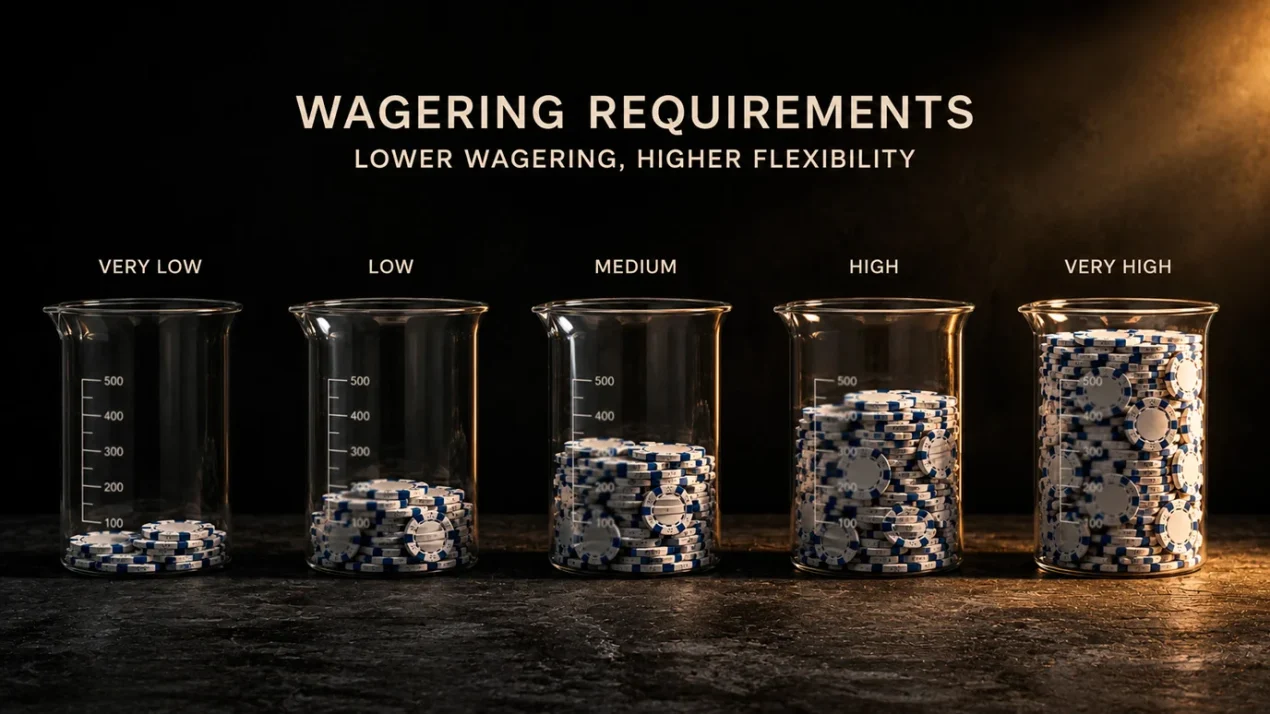
The Label That Refused To Die
I was convinced — genuinely, professionally convinced — that the ‘low wagering’ marketing label would disappear within six months of the 10× cap coming into force. The argument seemed obvious. If every bonus on the market is capped at 10× by regulation, what could ‘low wagering’ possibly mean any more? Everything is low. The label is redundant.

I was wrong. The label is still everywhere, and it is doing real work in the post-reform market. The reason is that the cap is a ceiling, not a target. Operators are free to set wagering below 10× if they choose, and the brands that have built their identity around player-friendly mechanics are using the gap between ‘1× and 10×’ as a marketing differentiator. The label survived because the spectrum it describes still exists — just compressed into a narrower range. The full picture is in our guide to the UK casino welcome bonus.
What Counts As ‘Low’ Now
The honest definition of low wagering in 2026 is anything strictly below the 10× ceiling. That is a wider band than it sounds. A 1× requirement is functionally wager-free for most slot players, because a single qualifying turn satisfies the condition on a 100%-weighted game. A 5× requirement is real friction, but mild — the expected loss across the turnover is half of what a 10× offer extracts. The market shape has bunched into three clusters: 1×, 5×, and 10×. Anything between 6× and 9× is essentially absent, presumably because the operators that want a player-friendly position go to 5×, and the operators that want the maximum house edge stay at the 10× ceiling.

This three-cluster shape is the cleanest visible artefact of the LCCP reform. Before January 2026, wagering values formed a smooth distribution from 20× to 65× across the welcome category. The reform truncated the distribution at 10×, and the surviving values clustered around the focal points that made commercial sense. Five times is the natural midpoint of the new range. One time is the floor that brands compete on. Ten times is the ceiling that brands optimise to.
The Commission’s stated rationale for the cap is that capping the wagering ‘decreases the likelihood of harm, reduces complexity, and improves transparency while maintaining consumer choice’. The bunching of operator behaviour at 1×, 5× and 10× is exactly what ‘maintaining consumer choice’ looks like when the upper bound is set firmly. The choice is across a narrower spectrum than before, but the spectrum is more decision-relevant — every value in the range now matters.
The Spectrum From One To Ten
The friction differential across the 1× to 10× range is more meaningful than it appears, because of how variance interacts with turnover. At a 4% house edge, the expected loss on £200 of turnover is £8. At £1,000 of turnover it is £40. The total turnover required scales linearly with the wagering multiple, so the expected loss scales the same way. A 1× offer extracts roughly one-tenth of the expected friction a 10× offer does.
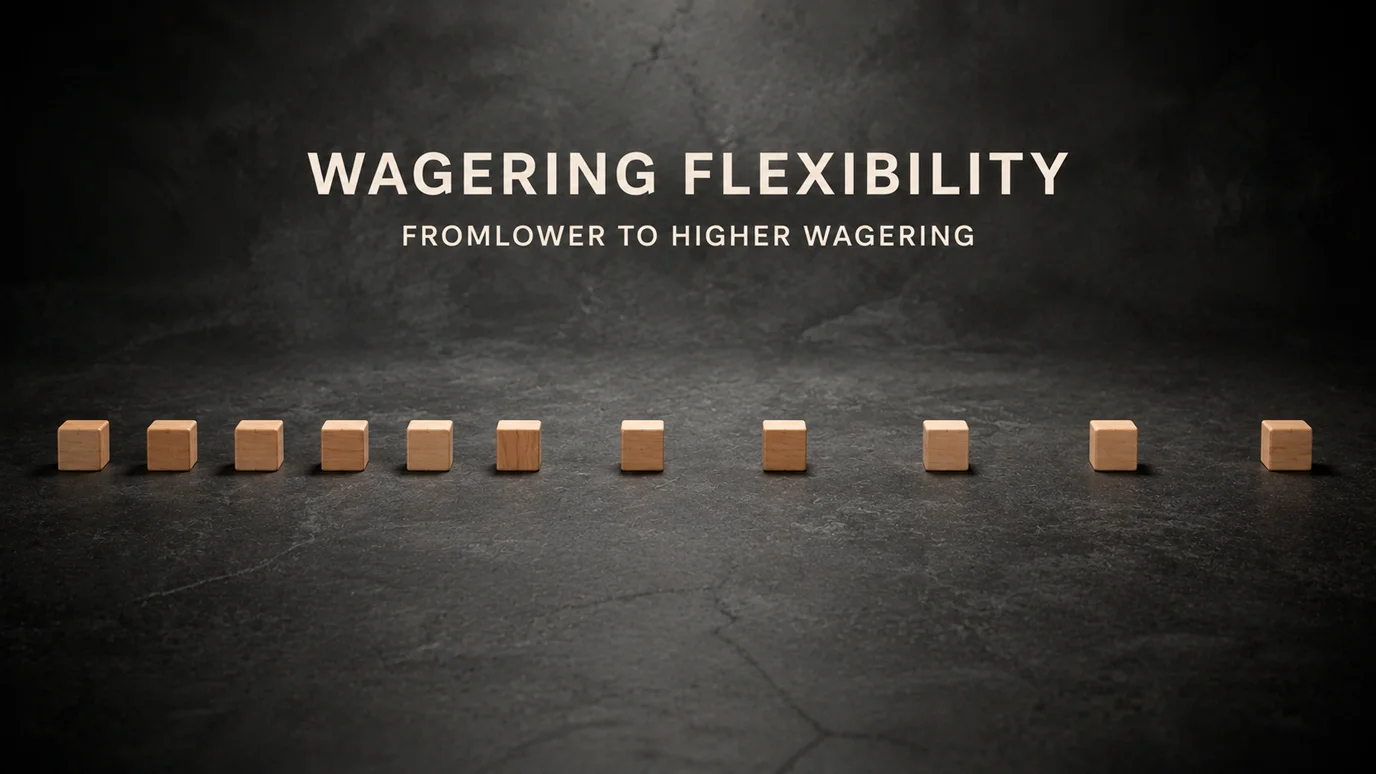
The variance picture is more nuanced. Higher turnover requirements give the player more chances to hit positive variance windows, which is why some heuristic players prefer 10× offers with a generous conversion cap to 1× offers with a tight cap. The argument is that the longer playthrough exposes the bankroll to more opportunities for a meaningful win. Empirically, that argument is correct in the upper tail and wrong in the median. Most 10× clearances do not exceed the modal payout of a 1× offer, because the variance is symmetric — high turnover gives more chances for big wins and more chances for big losses, with the house edge biasing the cumulative outcome downward.
The most useful way to compare offers across the 1× to 10× range is to start with the headline value, compute the expected loss across the implied turnover, and check the conversion cap. The offer with the highest residual after friction and capped at a ceiling that exceeds the bonus value is usually the best for the median player. That arithmetic favours low-wagering offers more often than it favours high-headline 10× ones, even when the high-headline figure looks much larger. The full breakdown of how wagering arithmetic interacts with conversion ceilings and contribution percentages is worth working through if the comparison feels counterintuitive.
Who Still Runs Low Wagering And Why
The brands that have built their identity around low wagering tend to share three characteristics. They are mid-sized rather than the largest incumbents. They have spent marketing budget on player-friendly positioning rather than on celebrity endorsements or stadium sponsorships. And they tend to skew toward repeat play over single-acquisition spend — the welcome offer is engineered as a relationship opener, not as a brute-force acquisition lever.

The commercial maths for this positioning is finer than the dominant 10× position. A 5× offer at the same headline value as a 10× offer costs the operator roughly twice as much per acquired player, because the turnover-derived recovery is half as much. The compensation has to come from somewhere — usually a smaller headline, a tighter conversion cap, or a higher minimum qualifying deposit. The trade-off is usually visible in the small print if you compare two offers side by side at the same brand class.
One of the underappreciated drivers of the low-wagering position is the Commission’s mandatory wagering requirements calculator. Operators have to display the turnover requirement in pounds, not as an abstract multiple. That visibility makes low wagering a directly comparable advantage on the landing page — a £100 turnover requirement next to a £200 turnover requirement is a difference any player can read, where 5× versus 10× would have required mental arithmetic before. The calculator turned the wagering multiple into a marketing primitive in its own right, and the brands that wanted to win that primitive moved down the spectrum.
Five Times Versus Ten Times In Real Numbers
Take two offers with identical headlines: £20 bonus on a £20 minimum deposit, conversion ceiling of £80, slot weighting at 100%. The only difference is wagering — one at 5×, one at 10×.

The 10× offer requires £200 of turnover. At a 4% house edge the expected friction is £8. Starting from a £40 playing balance, the expected closing balance after wagering is roughly £32. Conversion ceiling is not binding at that level, so the expected residual is the same as the expected closing balance.
The 5× offer requires £100 of turnover. The expected friction is £4. Starting from the same £40 playing balance, the expected closing balance is £36. Again, the conversion ceiling is not binding. The 5× offer is worth £4 more in expected value than the 10× offer, all else equal.
That margin sounds small in absolute terms. As a fraction of the £20 bonus headline, it is 20% of the value of the offer. Across many claims and many sessions, the gap compounds — a player who consistently picks 5× over 10× will, on average, take £4 more home per offer than the player who consistently picks 10×. The headlines look identical; the lived returns diverge meaningfully.
The Sneakier Constraint: Time
One thing that does not appear in the wagering arithmetic but matters in practice is expiry. Low-wagering offers often have shorter expiry windows than 10× offers, partly because the operator wants the bonus to clear or expire quickly, and partly because the player-friendly positioning is more credible with a tight loop than a long one. I have seen 5× offers with 7-day expiries against 10× offers with 30-day expiries from the same brand.

A short expiry can change the practical EV substantially. A 5× offer that requires £100 of turnover within 48 hours is achievable for a player ready to commit a long session, but punishing for a casual player who might want to spread the clearance across a fortnight. The 10× offer with a 30-day expiry is, in practice, more flexible despite the higher friction. The comparison comes down to the player’s actual play pattern, not the optimal play pattern. For most readers, the player-friendly positioning of a low-wagering offer is worth taking — provided the expiry is honest about how quickly the clearance has to happen. The full picture is in our guide to the UK casino welcome bonus.
Frequently Asked Questions
Why didn’t the 10× cap eliminate the ‘low wagering’ marketing label?
The cap is a ceiling, not a target. Operators that want a player-friendly position still have room to set wagering below 10×, and the 1× to 10× spectrum has compressed into clusters at 1×, 5× and 10×. The label survives because the difference between a 1× requirement and a 10× requirement is still substantial in expected value terms — a 1× offer extracts roughly one-tenth of the friction a 10× offer does. The mandatory pound-denominated wagering calculator made the comparison easier to read on the landing page, which sharpened the marketing advantage.
Are 5× wagering offers measurably better-EV than 10×?
Yes, by a margin that scales with the bonus headline. At a 4% house edge, the expected friction across a 5× offer is half what it is across a 10× offer at the same bonus value. For a £20 bonus, the difference is roughly £4 — about 20% of the bonus headline. The advantage is visible in the expected closing balance and survives most reasonable assumptions about house edge, conversion cap and variance. Across many offers and many sessions, the gap compounds reliably.
Does a low-wagering offer always pair with a smaller headline £?
Almost always. The operator has to recover the cost of the bonus from somewhere, and the lower the wagering, the smaller the recovery via house edge during clearing. The compensation usually shows up as a lower headline figure, a tighter conversion cap, a higher minimum qualifying deposit, or a shorter expiry. Comparing a 5× £10 bonus to a 10× £25 bonus at the same brand class is a fair frame; expecting a 5× offer at the same headline as a competing 10× offer rarely matches what actually exists in the market.
This material was created by the WagerVane team.
Related posts

Casino Welcome Bonus Withdrawal: From Wagering Clear to Bank Account

Live Casino Welcome Bonus UK: Why Dealer Tables Are Usually Excluded