Welcome Bonus KYC: What UK Operators Check First
 Available in GB
The Single Point Where Most Bonuses Die
I have watched more welcome bonuses fail at KYC than at any other stage of the journey — including wagering. Wagering is a long, gradual erosion that some players survive and some do not. KYC is a single gate that either opens or it does not. When it does not, the bonus typically expires before the dispute is resolved, and the player is left with a closed account and an unclear path forward.

This is not an accident, and it is not the operator being difficult. The Commission’s tightening of customer due diligence through 2025 — including the lowering of the financial vulnerability check trigger to £150 over thirty days — turned KYC from a back-office process into a real-time gate at the front end of the player experience. The change improved player protection materially. It also meant that anyone wanting a welcome bonus has to navigate a verification step that did not exist in this form a decade ago. The full picture is in our guide to the UK casino welcome bonus.
Our top casino picks for the UK
- EvoSpinBonus: 125% up to €2500 + 125 Free Spins · Payout speed: 1-3 business days
- x3betBonus: Welcome Pack 100% Up to £1.000 + 200 Free Spins · Payout speed: 1-3 business days
- ChanzeBonus: Slots Welcome Bonus #1 200% up to €500 · Payout speed: 1-3 business days
- SlotoSportBonus: 500% up to £ 10 200+ 777 FS · Payout speed: 1-3 business days
- NightLuckBonus: Welcome Pack + 805% Up To 6400€ + 280 FS · Payout speed: 1-3 business days
- WinBeastBonus: €5000 + 500 FS + €650 Freebet · Payout speed: 1-3 business days
What The Documents Usually Are
Every UKGC-licensed operator runs a near-identical core KYC stack, with minor variations in the exact list and the order of requests. The starting point is government-issued photo identification — passport, driving licence, or in some cases a national identity card from another country if you are a UK resident with non-UK citizenship. Quality matters. A photograph taken at an angle, with glare obscuring the data zone, or with corners cropped off will fail automated review and route the case to manual handling, which adds days.
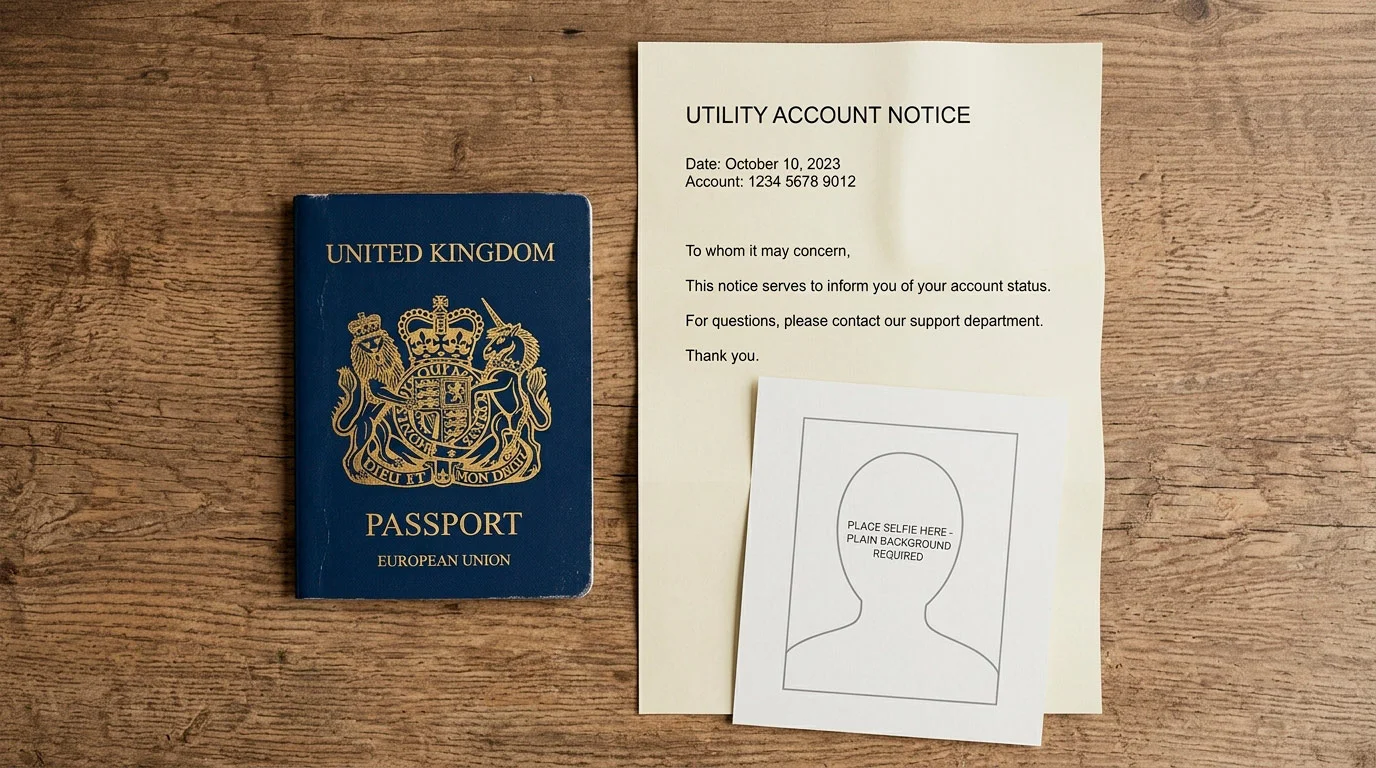
Proof of address is the second pillar. Bank statements dated within the last three months are the most reliably accepted. Utility bills work if they are issued by a recognised provider and include the player’s full address as registered on the account. Mobile phone bills are accepted by some operators and rejected by others — the reasoning is that mobile bills are easier to forge than utility or banking documents, so the document risk profile is higher. Council tax notices and HMRC correspondence are accepted at almost every operator.
A third document increasingly common in 2026 is biometric verification — typically a selfie video where the player turns their head left and right while holding their ID document next to their face. The video is fed to a facial recognition system that cross-matches the live face against the photograph on the ID. This step has become standard at the larger operators and is spreading to the rest of the market. It catches some categories of fraud that document-only verification misses, and it adds perhaps a minute to the player’s onboarding workflow.
Automated Versus Manual: Which Path Your Case Takes
Most KYC checks at UK operators in 2026 are automated. Document images are processed by optical character recognition, the extracted data is cross-checked against the account information, and the facial recognition pass runs in parallel. When all three subsystems return consistent results, the verification clears in seconds to minutes. The player rarely sees the process at all — the account opens, the bonus credits, and play begins.

Manual review is the alternative path. It is triggered when automated systems flag any inconsistency: blurred document images, name mismatches between channels, addresses that do not match credit reference agency records, or transaction patterns the operator considers worth a human look. The Commission’s voluntary affordability code, launched in May 2024, formalised some of the triggers across the industry. The code’s stated intent was to ensure ‘a consistent and transparent approach for consumers across participating operators where customer spend is the trigger for action’. The same consistency applies, less formally, to the front-end KYC review.
Manual review at the larger operators typically resolves within 24 to 48 working hours during business days. At smaller operators or during peak periods it can stretch to five working days. Where the welcome bonus has a 7-day activation clock, that delay can absorb the entire window. The bonus expires, the verification eventually clears, and the player is left with an open account and a closed promotional offer. Operators usually do not reinstate expired welcome bonuses retroactively, even when the delay was on their side. This is the single biggest reason I encourage readers to upload documents the moment the operator presents the verification form, rather than waiting until after first deposit.
Timing Friction And The Bonus Expiry Clock
The timing dynamic deserves a clear explanation because it is the single most common source of complaint emails I receive in this category. The bonus activation clock starts at credit, which is usually at the moment of qualifying deposit. KYC can be running before, during or after the deposit depending on the operator’s workflow. If KYC is incomplete at the moment of credit, some operators hold the bonus pending verification — meaning the activation clock has not yet started, and the player has time. Other operators release the bonus immediately and let the player accumulate wagering progress on an unverified account, with any withdrawals blocked until verification clears. Verification gates the payout: the withdrawal route.

The second model is the more dangerous one for the player. If verification fails after wagering has cleared, the cumulative balance can be voided as part of the failure resolution. The operator is within rights to do this under standard T&Cs, and the player has limited recourse if the failure was caused by a genuine document mismatch. The cleaner model is the first one — bonus held until verified — but the market is split, and the model can vary even within the same operator’s product lines.
The Commission’s enforcement statistics during 2025 give a sense of how seriously verification is being treated at the regulatory level. Between April and December, the Commission issued 592 cease and desist notices to non-compliant entities, reported 327,964 URLs to search engines, and secured the removal of 203,571 URLs. That activity sits behind the front-end KYC requirements — operators that fail to enforce verification properly risk regulatory action, which is part of why automated systems have become so thorough. The flip side is that genuine players occasionally get caught by overzealous heuristics, and patience plus documentation is the only practical response.
What Happens When Verification Fails
A failed verification has three possible outcomes. The first is a resolvable failure — a document was unclear, the wrong file was uploaded, or a name field was mistyped. The operator requests additional documentation and the process restarts. Most failures are in this category, and the resolution timeline is one to three working days for cooperative players.
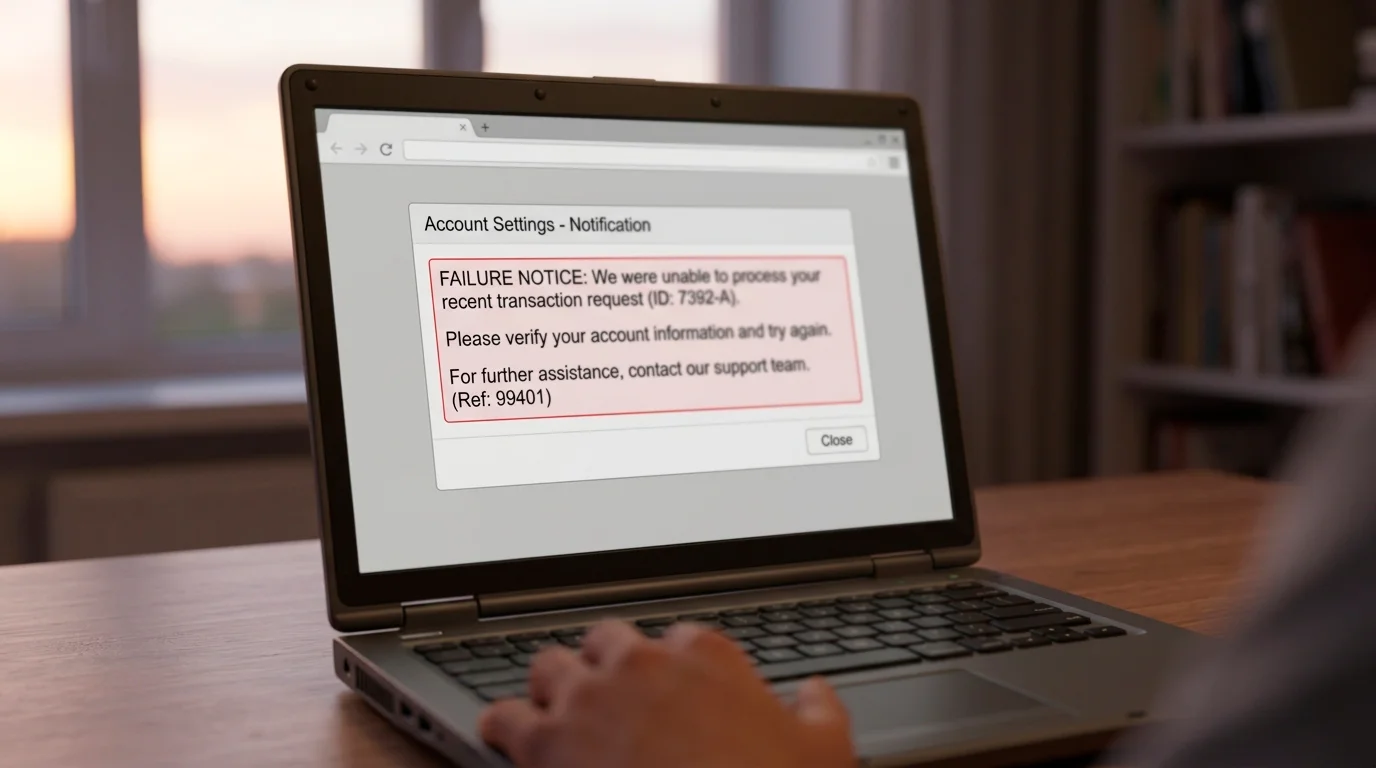
The second is a partial failure — verification clears for the account but the bonus is denied. This usually happens when the operator’s fraud system detects a pattern that suggests duplicate registration or bonus abuse. The account remains open for ongoing play with deposited funds, but the welcome offer is removed. The financial vulnerability check trigger at £150 over thirty days can also produce this outcome when the operator concludes that a bonus would not be responsible to extend, even if the account passes basic identity verification.
The third is a full failure — verification cannot be completed, the account is closed, and any funds deposited are returned to the source instrument. This is rare and usually involves either documents that cannot be authenticated or a positive match against a self-exclusion register such as GamStop. The full closure outcome is final. The deposited funds return to the player; the bonus does not release; and the operator’s records flag the closure for future cross-checks. The wider picture of how the £150 affordability check threshold interacts with welcome bonus eligibility is worth reading alongside this if your deposit volume is at or near the trigger.
The Quiet Discipline That Resolves Most Cases
Most KYC issues resolve themselves if the player is patient and responsive. The pattern that fails almost every time is the player who uploads a single document, waits silently for an outcome, and then escalates publicly when nothing happens. The pattern that succeeds almost every time is the player who uploads good-quality documents promptly, responds within a working day to any follow-up request, and lets the operator’s process run without complication.

The operator’s KYC team has no incentive to delay verification. Their workload is processed first-in, first-out, and a complete case file clears faster than a partial one. The friction the player experiences is structural — driven by document quality, document choice, and timing relative to the bonus clock — rather than discretionary. Treating it as a process to be navigated, not an obstacle to be argued with, produces materially better outcomes.
Frequently Asked Questions
Can wagering be done before KYC clears or only after?
It depends on the operator’s chosen model. Some hold the welcome bonus until verification completes, so wagering cannot start until the player is verified. Others release the bonus on deposit and allow wagering on an unverified account, with withdrawal blocked until KYC clears. The second model is faster but riskier, because failed verification after wagering has produced a balance can result in that balance being voided. The first model is slower at the start but cleaner if anything goes wrong at the verification stage.
What is the typical resolution time for manual verification in 2026?
Manual review at the larger UK operators resolves in 24 to 48 working hours during business days. Smaller operators and peak periods can stretch this to five working days. Where the welcome bonus has a 7-day activation clock, the manual review can absorb the entire window. Uploading high-quality documents immediately after registration, before the bonus credit triggers, is the most reliable way to keep the verification timeline shorter than the bonus expiry.
Does a partially verified account forfeit the welcome bonus on expiry?
Usually, yes. If the bonus activation clock expires before verification completes, the offer is treated as having lapsed unused. Operators rarely reinstate the bonus retroactively, even when the delay was on the verification side. The deposited funds remain available for ordinary play, and verification can still clear afterwards — but the welcome offer specifically does not return. This is why uploading documents at registration, not at first deposit, is the discipline that protects the bonus most reliably.
This material was created by the WagerVane team.
Related posts

Terms of Use

UK Gambling Casino Sites and Slots: Licensing and Play